Kalash Uchal Festival Tour (2026) – 8 Days & 7 Nights
Celebrate one of Pakistan’s most vibrant indigenous festivals in the remote mountain valleys of the Hindu Kush with our 8-Day Kalash Uchal Festival Tour.
About this journey
Celebrate one of Pakistan’s most vibrant indigenous festivals in the remote mountain valleys of the Hindu Kush with our 8-Day Kalash Uchal Festival Tour. This summer adventure, curated by PASSAGE TO PAKISTAN, offers a rare opportunity to witness the ancient customs, dances, and rituals of the Kalash people—one of the world’s last remaining pagan cultures.
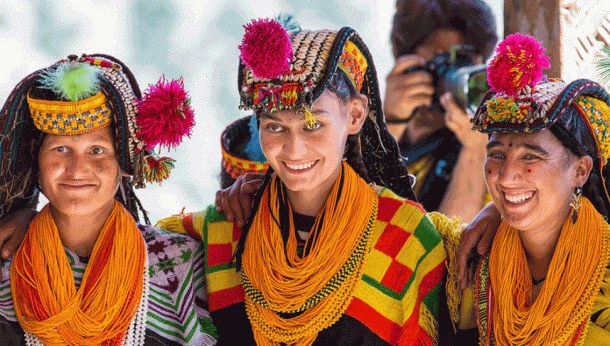
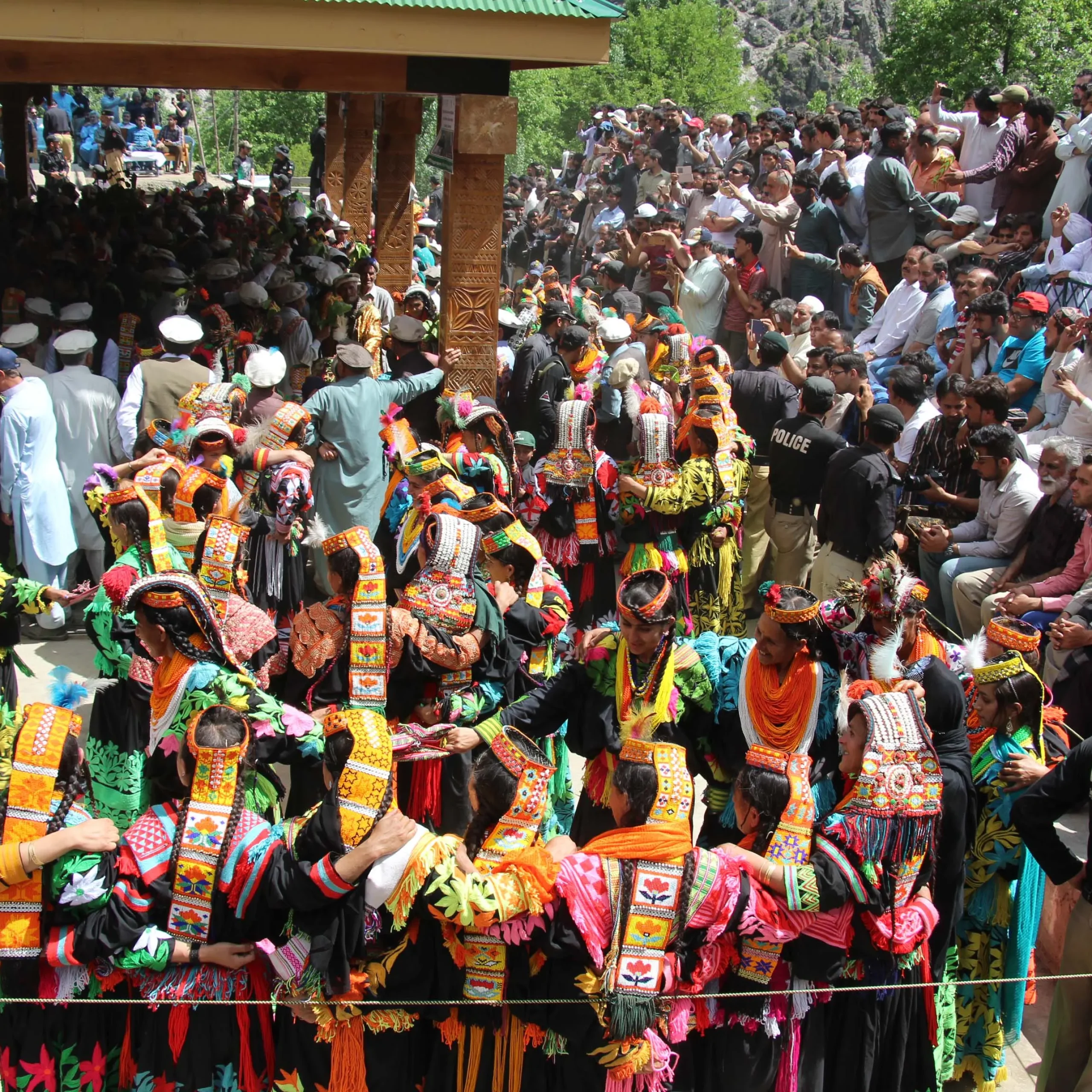
The Uchal Festival, held annually in August, marks the end of the wheat harvest and the beginning of a new agricultural cycle. It’s a time of joy, music, and communal thanksgiving to the deities of nature. As a guest of the Kalasha in Bumburet Valley, you’ll experience their colorful attire, soulful chants, and hypnotic circle dances—set against a backdrop of alpine beauty and crisp mountain air.
Your journey begins in Islamabad, followed by a scenic drive through the lush hills of Swat Valley, where you’ll explore the historic town of Mingora and the serene beauty of Malam Jabba or Fizagat.
Continue onward to Chitral, nestled in the shadow of Tirich Mir, the highest peak in the Hindu Kush. Here, you’ll visit the iconic Shahi Mosque, Chitral Fort, and explore bustling bazaars before heading to the legendary Kalash Valleys.
In Bumburet, the heart of Kalash culture, you’ll stay in locally run guesthouses and join the community in their Uchal celebrations. Learn about Kalash mythology, attend traditional rituals, share meals with village elders, and witness how this unique culture has preserved its identity for millennia.
The tour concludes with a relaxing return through Swat, offering scenic views, forested hills, and charming villages—a soft landing after an unforgettable cultural deep-dive.
With PASSAGE TO PAKISTAN, enjoy the perfect blend of comfort, authenticity, and adventure on this once-in-a-lifetime cultural experience.
Day by day
Day 1: Arrival in Islamabad
Your guide meets you at Islamabad International Airport and transfers you to your hotel in the heart of the capital. Islamabad is one of the world’s youngest and most deliberately planned capital cities — laid out in the 1960s in a grid of tree-lined sectors beneath the Margalla Hills, a spur of the Himalayas. If you arrive with time to spare before sundown, the grand Faisal Mosque — the largest mosque in South Asia, built between 1976 and 1988 with Saudi funding and a striking desert-tent design — is a short drive from most city hotels and an extraordinary first impression of Pakistani monumental architecture. Your guide will join you for a welcome briefing over dinner, going through the route, the cultural customs of the Kalash people, and any questions you have about the days ahead. Overnight in Islamabad.
Day 2: Islamabad to Swat Valley (approx. 6–7 hours)
After breakfast, you head north-west through the Hazara Division toward Swat — a broad, forested valley that Alexander the Great entered in 327 BCE and which Rudyard Kipling described as the most beautiful place in the subcontinent. The road follows the Swat River upstream from Mingora, passing through stands of cedar and pine that close in on both sides as the valley narrows. Swat was a princely state until 1969 and retains a distinctive cultural character shaped by Pashtun tradition, a rich Buddhist heritage (the Swat Museum holds one of the finest Gandhara collections in Pakistan), and some of the freshest mountain air in northern Pakistan. You check in at your hotel in Mingora or Saidu Sharif by evening — time for a short walk along the river bazaar before dinner. Overnight in Swat.
Day 3: Swat to Chitral via Lowari Tunnel (approx. 7–8 hours)
Today you cross one of Pakistan’s most dramatic mountain thresholds. From Swat you drive north-west through Dir District to the entrance of the Lowari Tunnel — a 8.5-kilometre road tunnel through the Hindu Kush that was completed in 2017 and replaced the seasonal, weather-dependent Lowari Pass (3,118m) as the primary route into Chitral. Before the tunnel opened, Chitral was cut off entirely every winter; today it is accessible year-round, though the approach from Dir is still a mountain drive that commands respect. Emerging from the tunnel into the Kunar River valley, the landscape changes completely: drier, wider, with the snow-capped peaks of the Hindu Kush lining the northern skyline. Chitral town sits at 1,500 metres on the banks of the Chitral River and is home to a famous polo ground, a small but characterful bazaar, and the imposing Chitral Fort. Depending on your arrival time, a brief visit to the Shahi Mosque or the fort may be possible before checking in. Overnight in Chitral.
Day 4: Chitral to Bumburet — Kalash Valley (approx. 2–3 hours) and Opening Festival Celebrations
A short but significant drive south from Chitral brings you to Ayun, the small market town at the junction of the three Kalash valleys (Bumburet, Rumbur, and Birir). From Ayun a gravel road follows the Bumburet River upstream into a world that looks and feels entirely unlike anywhere else in Pakistan. The Kalash people — around 3,000 to 4,000 individuals who practice a pre-Islamic animist religion with deep roots in the ancient world — live in closely spaced wooden houses on the valley sides, tending terraced fields of maize, walnut, and mulberry. The women wear distinctive black robes and elaborate headdresses of cowrie shells, buttons, and embroidery; the men dress in the same style as broader Pakistani mountain communities but are unmistakably Kalash in their bearing and hospitality. You arrive in time for the opening day of the Uchal Festival, one of three major annual Kalash celebrations (alongside Chilam Joshi in May and Choimus in December). Uchal marks the midsummer ripening of the crops and is honoured with dancing, singing, offerings to the gods, and the slaughter of goats whose blood is symbolic of thanks. Your guide introduces you to community members and helps you navigate the festivities respectfully. Overnight in a guesthouse in Bumburet.
Day 5: Full Day at Uchal Festival
The heart of the tour. The Uchal celebrations on the second day are typically the most vivid: processions from the villages to the sacred altars (bashali and jeshtak-han), communal dancing in long lines with women leading, offerings of bread and walnuts to the deities, and — in the afternoon — feasting and toasts with traditional Kalash grape wine. The Kalash are among the very few communities in Pakistan for whom alcohol is not merely legal but ritually required; the wine is home-produced and offered in a spirit of hospitality that is as genuine as anything you will encounter on any journey. Your guide accompanies you throughout, explaining the significance of each ritual and introducing you to Kalash men and women who are accustomed to respectful visitors. Photography is generally welcomed but always requires asking first; your guide will facilitate introductions. The pace of the day is relaxed and unhurried: there is no schedule to meet, only a festival to experience. Overnight in Bumburet.
Day 6: Excursion to Rumbur Valley and Kalasha Dur Museum (approx. 1–2 hours each way)
With Uchal winding down, today offers a chance to explore the lesser-visited Rumbur Valley — a quieter, narrower valley north of Bumburet where the Kalash community lives in a particularly traditional way, with fewer visitors and a slower pace of daily life. The drive from Bumburet to Rumbur is itself beautiful: the Bumburet River gorge opens into a wider basin before the road climbs into the pine forest that gives Rumbur its cooler, shadier character. You return via the Kalasha Dur Museum in Bumburet, which opened in 1995 with support from the Greek government and houses a small but thoughtfully curated collection of Kalash historical artefacts, traditional garments, and documentation of the community’s oral traditions and cosmology. The museum is an important counterpoint to the festival itself: it provides the scholarly and historical context that makes the living culture more comprehensible. The afternoon is free in Bumburet for further exploration, a walk to the upper terraces, or simply sitting with community members and sharing tea. Overnight in Bumburet.
Day 7: Bumburet to Swat Valley (approx. 8–9 hours)
Departing the Kalash valleys and retracing the route through Chitral and the Lowari Tunnel, you make the long return drive east toward Swat. The journey gives you time to process what you have experienced — the Kalash community is one of the most unusual and historically puzzling in the world, with theories about their origins ranging from descendants of Alexander’s soldiers to practitioners of a Vedic religion that predates the Aryan migration into South Asia. None of these theories is definitively established, but all of them attest to the uniqueness of a community that has maintained its identity, religion, and way of life against centuries of pressure. You arrive in Mingora or Saidu Sharif by evening for dinner and an overnight rest before the final day of travel. Overnight in Swat.
Day 8: Swat to Islamabad — Departure
The final day follows the Swat River south and then east through Mardan and Attock to Islamabad — a drive of approximately six to seven hours through the fertile Punjab foothills before the Potohar Plateau opens up ahead of you and the Margalla Hills come back into view on the northern horizon. Your guide will drop you at your hotel or directly at the airport depending on your departure time. If you have an evening or night flight, there may be time for a final meal in Islamabad — the Monal Restaurant perched on a Margalla Hills spur at 900 metres offers spectacular views over the capital and a farewell feast of Pakistani grilled meats, naan, and Peshwari chicken karahi that makes for a memorable last dinner. Tour ends on arrival in Islamabad.
What you will experience
- Celebrate Uchal Festival with the Kalash community in Bumburet
- Enjoy springtime rituals, dance, and music in traditional Kalasha attire
- Visit the colorful Kalasha Dur Museum and cultural shrines
- Explore Chitral Fort, Shahi Mosque, and cross the scenic Lowari Tunnel
- Relax in the beautiful valleys of Swat and Chitral
What to bring
A practical starting point for this trip. Your guide will send a final, weather-checked list two weeks before departure.
Documents & essentials
- Passport valid 6+ months, plus photocopies stored separately
- Pakistan visa or e-visa confirmation printout
- Travel insurance certificate (mandatory — must cover altitude if trekking)
- Flight tickets and this itinerary, printed and on your phone
- Cash in USD or EUR for exchange; cards are not widely accepted outside major cities
- Passport-sized photographs for permits and hotel registration
Clothing
- Layered clothing — northern valleys are cool at night even in summer
- Fleece or insulated jacket for high passes such as Khunjerab and Babusar
- Light waterproof jacket
- Comfortable walking shoes plus sandals or trainers
- Modest clothing covering shoulders and knees for mosques, forts and villages
- A scarf or shawl (women should carry one for religious sites)
- Sun hat and sunglasses — UV is intense at altitude
Health & personal care
- Personal medication with a copy of the prescription
- Basic first-aid kit: blister plasters, painkillers, antihistamine, rehydration salts
- Anti-diarrhoeal and a broad-spectrum antibiotic if your doctor advises it
- High-factor sunscreen (SPF 50) and SPF lip balm
- Insect repellent
- Hand sanitiser and wet wipes
- Toilet paper — not reliably supplied outside hotels
Electronics
- Universal adapter — Pakistan uses type C and D sockets, 230 V
- Power bank; mains power is intermittent in mountain areas
- Camera with spare batteries — cold drains them quickly
- Phone with offline maps downloaded before departure
Good to have
- Reusable water bottle to reduce plastic waste
- Small padlock for luggage
- Snacks you like — choice is limited outside cities
- Earplugs and eye mask for long drives and shared lodges
- A small gift or postcards from home if you plan to visit local families
Before you travel
Best Time to Visit Chitral and the Kalash Valleys
Chitral District in the far north-west of Khyber Pakhtunkhwa is one of Pakistan’s most dramatic and culturally distinctive destinations, bordered by Afghanistan to the west and overlooked by Tirich Mir at 7,708 metres — the highest peak in the Hindu Kush range. The best time to visit depends on what draws you: if the Uchal Festival is the purpose of the journey, August is your fixed point, and the climate cooperates warmly. August in the Kalash valleys brings daytime temperatures of 25–30°C in the lower valleys with clear skies, and the three valleys of Bumburet, Rumbur, and Birir are at their lushest — walnut and mulberry trees in full leaf, the terraced fields green, and the sound of festival drums carrying between the valley walls.
The spring shoulder season of late March through May offers a very different character: apricot and cherry orchards in the Chitral valley bloom in profusion, the landscape is vivid with new growth, and the Kalash celebrate the Chilam Joshi spring festival in mid-May — another of their three great annual celebrations. Travel is easier in spring than in winter or early summer when snowmelt can render the roads difficult, and the cooler temperatures of April and May — 15–22°C — make walking between the Kalash villages particularly pleasant. The great mountain views, including the ice-plastered summit pyramid of Tirich Mir rising above the Chitral Valley, are often clearest after rain in spring.
June and early July bring rising temperatures and the occasional afternoon thunderstorm as the edge of the South Asian monsoon brushes Chitral’s outer ranges. The valleys remain accessible and green, and visitor numbers are lower than at festival time, giving a more intimate experience of Kalash village life. The Chitral Gol National Park, which protects a population of snow leopards, markhor, and ibex above the treeline, is accessible during the summer months for wildlife-focused excursions. Late July sees the temperature peak at around 32–35°C in the valley floor — hot by mountain standards — before the Uchal Festival period in August draws both the temperature and the festive energy back into balance.
September and October bring the autumn harvest season to Chitral — a time of drying apricots, pressing grapes, and gathering walnuts from the ancient trees that line every field boundary in the Kalash valleys. The Chawmos winter solstice festival in December is the most sacred of the three Kalash celebrations, but the cold and reduced accessibility make it a more challenging visit. Snow typically closes the Lowari Pass above Dir from November through March, though the Lowari Tunnel, completed in 2017, now provides year-round road access to Chitral regardless of conditions above ground — a significant improvement that has extended the practical visitor season considerably.
Chitral is accessible by daily flights from Islamabad (approximately 35–40 minutes), operated by PIA on a seasonal schedule that can be subject to weather disruption due to the terrain. The overland route from Islamabad via Peshawar and Dir to the Lowari Tunnel takes approximately 9–12 hours by road and passes through some spectacular mountain scenery in the Dir Valley. The onward journey from Chitral town to the Kalash valleys takes a further one to two hours by 4WD vehicle on a paved but narrow mountain road. Your tour operator will arrange all transfers.
Travel Tips for UK Visitors
British passport holders qualify for a Pakistani e-visa or visa on arrival at Islamabad International Airport. The tourist visa is valid for 30 days and costs approximately £35–45 for UK nationals. The e-visa portal at visa.nadra.gov.pk is the recommended route — apply at least three to five days before departure, carry a printed copy, and have the digital version saved offline on your phone in case of connectivity issues at the airport. Your passport must have a minimum of six months’ validity remaining, and you will need to show a confirmed return ticket and proof of accommodation. There are no additional visa or registration requirements for visiting Chitral or the Kalash valleys specifically, though your tour operator will handle any local permits or formalities.
Flights from the UK to Pakistan connect through Dubai (Emirates), Doha (Qatar Airways), Abu Dhabi (Etihad), or Istanbul (Turkish Airlines), with total journey times of 14–17 hours including the connection. PIA operates a direct London Heathrow to Islamabad service on certain days of the week. From Islamabad, the domestic connection to Chitral takes approximately 35–40 minutes on a small turboprop aircraft. The approach into Chitral Airport, set in a narrow valley between steep walls, is one of the more dramatic landings in commercial aviation — a genuine experience in itself. When domestic flights are cancelled due to weather, the overland road via Peshawar and the Lowari Tunnel is the reliable alternative, adding a full day to the journey but providing its own rewards in terms of scenery.
The Pakistani Rupee (PKR) is the local currency, exchanging at approximately 350–360 PKR to the pound sterling at the time of writing. Cash is the only practical means of payment throughout Chitral and the Kalash valleys, where no ATM infrastructure exists. Carry enough Rupees for the entire trip from Islamabad, where exchange bureaux in the Blue Area and at the airport offer the best rates. Credit cards are not accepted at guesthouses, restaurants, or village stalls in the Kalash valleys. Budget approximately £15–25 per day for incidental spending on local crafts (the Kalash produce distinctive beaded jewellery, embroidery, and carved wooden items), meals, and gratuities. The handmade goods available in the Kalash valleys are genuinely beautiful and priced very modestly.
Health preparation for this tour follows the standard Pakistan protocol. Recommended vaccinations include hepatitis A, typhoid, and a tetanus booster. Chitral sits at around 1,500 metres above sea level, which means altitude sickness is not a significant concern on this particular tour unlike the high Karakoram routes. However, comprehensive travel insurance with medical evacuation cover remains essential, as the nearest well-equipped hospital is the Aga Khan Health Services facility in Chitral, and serious cases require evacuation to Peshawar or Islamabad. Carry a personal first-aid kit, oral rehydration salts, and anti-diarrhoea medication. Tap water is not safe to drink anywhere in Pakistan; use bottled or purified water consistently.
Accommodation on This Tour
In Chitral town, this tour uses comfortable mid-range guesthouses and small hotels that offer a genuine sense of place alongside reliable facilities. The Tirich Mir View Hotel and Dreamland Hotel are the two most consistently recommended properties in Chitral, both offering clean en-suite rooms, hot water, room service for basic meals, and the kind of attentive hospitality that is a hallmark of Chitrali culture. The views from upper rooms across Chitral town to the Tirich Mir massif are magnificent, particularly in the golden light of early morning when the summit ice fields glow above the valley mist. The town itself is a pleasant base for walks to Chitral Fort, the old bazaar, and the riverside masjid.
Within the Kalash valleys, accommodation is provided in traditional Kalash-run guesthouses built in the distinctive local style — solid timber-and-stone construction on the valley side, with flat roofs that double as living and working space for the families who own them. These guesthouses offer simple but clean twin and double rooms, shared bathroom facilities with cold or solar-heated water, and home-cooked Kalash meals. The food is a notable highlight: slow-cooked goat stew, freshly ground maize bread, sheep’s milk cheese, mulberry jam, and in August the first pressed grapes of the harvest season. Staying with Kalash families rather than in purpose-built tourist facilities is a deliberate choice and an important part of how this tour supports the local community economically.
The simplicity of the guesthouse accommodation in the Kalash valleys should be understood in the context of where you are: a remote, living mountain community that has been welcoming curious visitors for only a few decades. The beds are clean, the welcome is genuine, and the setting — surrounded by the wooden architecture and daily rhythms of one of the world’s most distinctive cultures — is irreplaceable. Guests who arrive expecting boutique hotel standards will be disappointed; guests who arrive ready to participate in what is essentially a homestay experience almost universally describe these nights as the most memorable of their entire Pakistan journey.
Local Culture and Etiquette in the Kalash Valleys
The Kalash people are one of the most remarkable human communities in the world. Numbering approximately 4,000 individuals across the three valleys of Bumburet, Rumbur, and Birir in Chitral District, they are the last practitioners of an ancient polytheistic religion in a region that has been Muslim for over a thousand years. Their faith centres on a pantheon of deities, seasonal festivals, a complex system of ritual purity and impurity, and a moral code with its own elaborate oral literature. They speak Kalasha, a Dardic language unrelated to Urdu or Pashto, and have maintained their distinct identity — dress, customs, and beliefs — in the face of centuries of external pressure.
The Uchal Festival, celebrated in August, is a harvest and thanksgiving celebration centred on the ripening of fruits, cheese production, and communal dancing in the ancestral shrine areas of each valley. Women dress in their most elaborate costumes — a long black robe called a shalwar or dress, a magnificent headdress called a kupras decorated with cowrie shells, buttons, and feathers, and long strands of coloured beads. The festival involves sustained communal singing and dancing in lines, ritual offerings, and the sharing of freshly made cheese and grape wine — the Kalash are among the very few communities in Pakistan who traditionally produce and consume alcohol as part of their religious practice, which makes the Uchal celebration a genuinely unique cultural experience in a predominantly dry country.
Visiting the Kalash valleys as a tourist requires a genuine commitment to respectful engagement. These are not a performance culture — the festivals and daily life are real, the people are not actors, and the community’s patience with intrusive visitors is not unlimited. Photography is permitted in most festival and village settings but requires active, informed consent: always ask directly before photographing individuals, particularly women and elders. Do not photograph inside the jeshtak (ancestral shrines) or bashali (women’s ritual space), which are sacred areas with strict purity rules. Do not enter a bashali under any circumstances. Do not attempt to touch, handle, or buy ritual objects. Your tour guide will brief you comprehensively on the relevant protocols before you enter each valley.
Dress respectfully throughout. In Chitral town, which is a Muslim community, standard modest dress applies — cover shoulders and knees, and women should carry a headscarf. Within the Kalash valleys, the rules are different: Kalash women do not cover their heads and are publicly active in festival and social life. However, visiting non-Kalash guests should still dress modestly as a mark of respect to their hosts. Do not bring alcohol into the valleys unless invited to share in what the community itself is producing — and even then, follow the lead of your guide. Tipping is welcome for guides and festival hosts; 300–500 PKR is appropriate per day. Purchasing handmade crafts directly from Kalash artisans is one of the best ways to support the community economy.
Safety and Health Information
Chitral and the Kalash valleys are significantly lower in elevation than the Karakoram routes, so altitude sickness is not a concern on this tour. Chitral town sits at approximately 1,500 metres and the Kalash valleys range from 1,900 to 2,400 metres — high enough for the air to feel fresh but well below the threshold for AMS in most visitors. The main physical demands of this tour are the valley walks between Kalash villages, which involve moderate gradients on good tracks, and the occasional jeep road transfer that requires sturdy footwear and a tolerance for rough surfaces. A moderate level of general fitness is sufficient.
The security situation in Chitral has improved markedly over the past decade, and the district is now considered one of the more stable and visitor-friendly destinations in Khyber Pakhtunkhwa. The Kalash valleys in particular have a long history of receiving international visitors without incident. That said, Chitral borders Afghanistan and geopolitical conditions in the wider region should always be monitored before travel — your tour operator will provide up-to-date security briefings and carries emergency communication equipment on all tours. The Foreign, Commonwealth and Development Office (FCDO) travel advice for Pakistan should be checked at gov.uk before booking and again shortly before departure.
Medical facilities in Chitral are provided by the Aga Khan Health Services hospital, which is the best-equipped facility in the district and offers a standard of care considerably above what exists in many comparable mountain areas. The nearest major hospital is in Peshawar, approximately seven to nine hours by road. Emergency numbers are 1122 for rescue services and 15 for police. Travel insurance with medical evacuation cover is mandatory on this tour and will be confirmed at booking. Carry personal medication, a basic first-aid kit, and oral rehydration salts. Stomach upsets from unfamiliar food and water are the most common ailments experienced by visitors — stick to bottled water, be selective about street food in the early days of the trip, and carry anti-diarrhoea medication as a precaution.
When to travel
Recommended travel window. Highlighted months are when we run this itinerary. Private departures can be arranged on any date — just ask.
Dates shown are guide departures. Exact start dates are confirmed at the time of booking and can be adjusted to suit your flights.
Plan your Cultural Gems of Pakistan – 8-Day Kalash Uchal Festival Tour
Tell us your dates and we will build this itinerary around them — private guide, your pace, your interests. We reply within one working day.
Or call +92 342 5017535
Questions travellers ask
1. When is the best time to visit the Kalash Valley for the Uchal Festival?
The Uchal Festival is celebrated in late August, marking the harvest season in the Kalash Valley. It’s the best time to visit for an authentic Kalash cultural experience, traditional dance ceremonies, and interaction with the local community in Bumburet and Rumbur.
2. Is the Kalash Valley tour safe for foreign and local tourists?
Yes, the Kalash and Chitral regions are generally safe and welcoming. Local police and community tourism organizations support cultural exchange and traveler safety. This tour includes registered guides and private transport, ensuring a secure and comfortable journey.
3. What should I pack for the Kalash Festival and Northern Pakistan travel?
Bring light layers, a warm jacket (especially for Chitral nights), sturdy walking shoes, sunblock, sunglasses, and respectful attire for cultural interactions. Don’t forget your camera for Kalash costumes, Swat landscapes, and historic Chitral sites!
4. What are the cultural highlights of this 8-day Kalash and Chitral tour?
Key highlights include the Kalash Uchal Festival, visits to Bumburet Valley, Chitral Fort, the Tirich Mir viewpoint, Swat’s Buddhist heritage sites, and the lush meadows of Malam Jabba. This is a perfect tour for cultural and nature lovers.
5. Are there any travel restrictions or permits required for Kalash and Chitral?
No special permits are needed for Pakistani nationals or foreign tourists. However, foreign visitors may need to register upon arrival in Chitral, which is arranged by our team. A valid passport, CNIC (for locals), and travel insurance are always recommended.