Pakistan is home to six UNESCO World Heritage Sites — a remarkable collection spanning 4,500 years of human history, from Bronze Age Indus Valley cities to Mughal imperial gardens and Buddhist monasteries perched on hilltops above the Peshawar plains. For UK heritage travellers, Pakistan’s UNESCO sites represent extraordinary value: world-class monuments in outstanding states of preservation, tiny tourist crowds, and experiences that place you alone at some of the most significant places in all of human history. This is heritage tourism as it used to be — before the Instagram hordes arrived.
These six inscribed sites, together with several candidates on Pakistan’s tentative list, form one of the most underrated heritage trails in the world. Here is everything you need to know about each one — and how to plan a visit.
Pakistan’s Six UNESCO World Heritage Sites
1. Mohenjo-daro — Inscribed 1980
Few places on earth carry the weight of antiquity quite like Mohenjo-daro. Dating to approximately 2600–1900 BCE, this ancient city on the west bank of the Indus River in Sindh was one of the first great urban settlements in human history — a metropolis of perhaps 40,000 people at a time when London was a marsh and Rome an unremarkable Italian hillside. The Indus Valley Civilisation of which it was a part was as sophisticated as contemporaneous cultures in Egypt and Mesopotamia, yet far less well known, largely because its script has never been deciphered.
Walking Mohenjo-daro’s excavated streets is a profoundly disorienting experience. The city was built on a grid plan — centuries before the Romans would claim credit for the idea — with standardised baked-brick construction, a centralised granary, and an underground drainage system so advanced that it would not be matched in Europe for another three millennia. The Great Bath, a large watertight pool at the heart of the upper city, suggests a culture in which ritual bathing played a significant role. Who used it, and why, we cannot say.
The site museum displays beautifully crafted artefacts: the famous bronze “Dancing Girl,” stone seals carved with animals and undeciphered script, jewellery, and pottery. The experience is quiet, atmospheric, and — when you allow yourself to absorb the scale of what has been lost — quietly devastating.
Location: Sindh province, near Larkana. Nearest airport: Mohenjo-daro Airport (MJD) or Karachi. Best time to visit: November to February.
2. Taxila — Inscribed 1980
Located just 35 kilometres from Islamabad, Taxila is one of the most important archaeological sites in Asia — and, because it is so accessible, one of the easiest UNESCO sites in Pakistan to visit. The inscription covers not a single site but a remarkable complex of three ancient cities and numerous Buddhist monuments spanning roughly seven centuries: from the Achaemenid period in the 5th century BCE through the Mauryan, Greek, Parthian, and Kushan eras to the 2nd century CE.
Taxila was a great centre of learning in the ancient world. The philosopher Chanakya taught here; Alexander the Great passed through. For several centuries it was also the heartland of Gandharan Buddhist civilisation — a cultural synthesis of Indian, Greek, Persian, and Central Asian influences that produced some of the finest Buddhist art ever created, including the first anthropomorphic representations of the Buddha in human form.
The three principal city sites — Bhir Mound (the original settlement), Sirkap (the Greek and Parthian city), and Sirsukh (the Kushan city) — can be explored in sequence. The Dharmarajika Stupa, a circular Buddhist monument of great antiquity, and Jaulian Monastery, a hilltop complex where monks’ cells, a main stupa court, and hundreds of smaller votive stupas survive in excellent condition, are not to be missed. The Taxila Museum, on site, provides essential context with an outstanding collection of Gandharan sculpture.
Location: 35km from Islamabad — an excellent day trip or combined with a night in Taxila. Best time to visit: October to April.
3. Fort and Shalamar Gardens, Lahore — Inscribed 1981
This inscription covers two adjacent monuments at the heart of Lahore’s Mughal heritage: the imperial fort and the formal gardens built by Shah Jahan for the woman he loved.
Lahore Fort (Shahi Qila)
Lahore Fort is one of the supreme achievements of Mughal architecture — a vast walled complex begun under Emperor Akbar in the 16th century and expanded by successive emperors over the following hundred years. Within its walls is an extraordinary sequence of courts, palaces, and audience halls that chart the evolution of Mughal taste from Akbar’s robust red sandstone to Jahangir’s experimentation and Shah Jahan’s refined white marble aesthetic.
The highlights are numerous. The Diwan-i-Aam (Hall of Public Audience) is a vast colonnaded pavilion where the emperor received petitions. The Diwan-i-Khas (Hall of Private Audience) hosted intimate imperial encounters. The Naulakha Pavilion — named for its supposed cost of nine lakhs of rupees — is a small, exquisitely proportioned white marble structure attributed to Shah Jahan, decorated with the finest pietra dura inlay work outside the Taj Mahal itself. And then there is the Sheesh Mahal: the Palace of Mirrors, an interior entirely encrusted with tiny convex mirror fragments set into white plasterwork, so that a single candle flame fills the room with a thousand reflections. It is one of the most breathtaking interiors in the subcontinent.
The fort is currently undergoing extensive and sensitive restoration under the Aga Khan Trust for Culture — a collaboration that is gradually returning these monuments to something approaching their original splendour.
Shalimar Gardens
In 1641, Shah Jahan commissioned the Shalimar Gardens — a formal Mughal garden laid out across three descending terraces, fed by a canal from the River Ravi. The gardens were created for his wife Mumtaz Mahal, the woman for whom he also built the Taj Mahal in Agra. They represent the apogee of the Mughal garden tradition: geometric water channels, hundreds of fountains, marble pavilions, fruit trees, and flower beds, all designed to evoke the paradise garden described in the Quran.
Shalimar rewards an early morning or late afternoon visit, when the light is golden, the fountains are running, and the gardens are quiet enough to feel as they were intended — a place of cool, ordered beauty at the heart of a great empire.
Location: Central Lahore. Best time to visit: October to March.
4. Historical Monuments at Makli, Thatta — Inscribed 1981
On a limestone plateau just outside the ancient Sindhi city of Thatta lies one of the most extraordinary places in the Islamic world. Makli Necropolis is one of the largest necropolises on earth: an estimated half a million tombs spread across 10 square kilometres, containing the royal dead of the Samma, Tarkhan, Arghun, and Mughal dynasties from the 14th to the 18th centuries.
The sheer scale of Makli is difficult to absorb on arrival. This is not a graveyard in any conventional sense; it is a vast funerary city, stretching to the horizon in every direction. Within that expanse you will find everything from simple brick graves to palatial domed mausoleums of extraordinary sophistication — carved sandstone monuments decorated with geometric interlace, calligraphic inscriptions, and figurative motifs; glazed tile tombs in brilliant turquoise and blue; and brick structures of impressive scale. The variety of funerary architecture on display across four dynasties and four centuries is unmatched anywhere in the Islamic world.
The nearby Shah Jahan Mosque in Thatta — built by the emperor after Thatta provided refuge to the young Mughal prince during a period of exile — is a stunning blue-and-white tile mosque of great elegance, well worth combining with a Makli visit.
Makli is located on UNESCO’s List of World Heritage in Danger. Its conservation challenges are real and urgent. Every visitor who comes helps make the case for the investment this extraordinary site deserves.
Location: 98km from Karachi — an excellent day trip. Best time to visit: November to February.
5. Rohtas Fort — Inscribed 1997
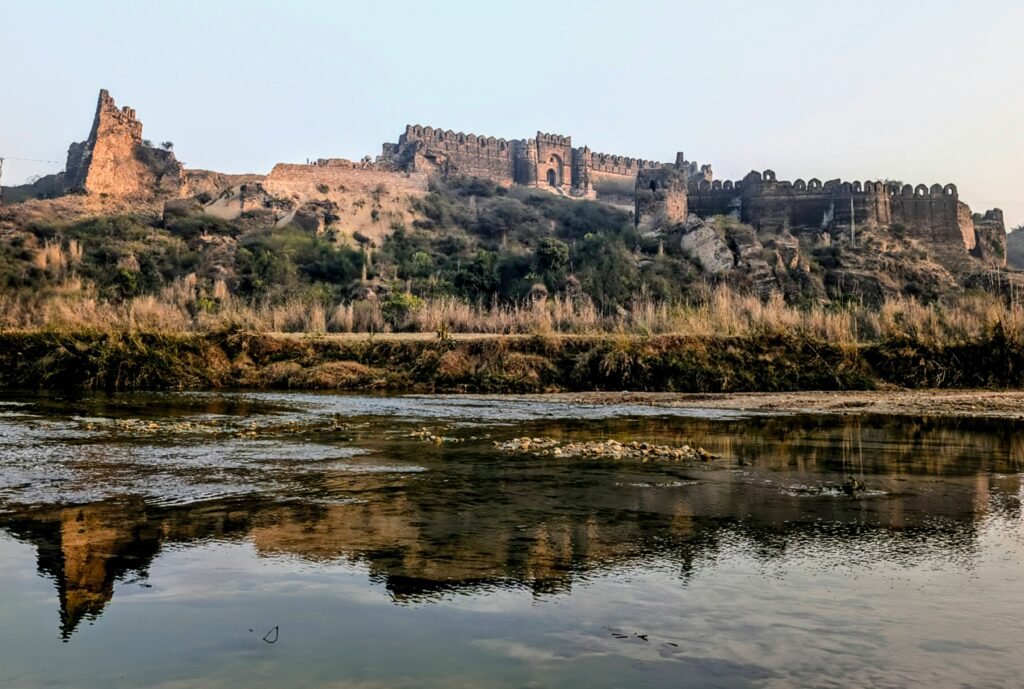
Rohtas Fort is the least visited of Pakistan’s UNESCO World Heritage Sites, and that is precisely what makes it so rewarding. Built in 1541 by Sher Shah Suri — the Afghan ruler who briefly ousted the Mughal Emperor Humayun from his throne — Rohtas is a massive military fortress, its walls stretching over four kilometres through the landscape of northern Punjab.
Sher Shah built Rohtas with deliberate speed and on an enormous scale, intending it as a base from which to control the subcontinent’s north. He did not live to see it completed, and the Mughals eventually retook their empire — but Rohtas survived. Its great gateways — the Sohal Gate, the Kabuli Gate, the Langar Khani Gate — are masterpieces of Afghan-Mughal military architecture: vast, towered, and elaborately decorated with geometric brickwork and carved inscriptions. The mosque within the fort, the Shahi Masjid, is graceful and well preserved.
What makes Rohtas genuinely unusual is the fact that it remains inhabited. A village exists inside the ancient walls, with families living in houses built among and against the medieval structures. Walking through the fort is to move between the medieval and the modern in the most immediate way — goats graze below ancient bastions; children play in gateways that once saw the movement of armies.
Location: Near Jhelum, Punjab — conveniently situated between Lahore and Islamabad, making it an excellent stop on a journey between the two cities. Best time to visit: October to March.
6. Takht-i-Bahi — Inscribed 1980
Perched on a rocky hilltop above the Peshawar plains, Takht-i-Bahi — Throne of the Spring — is the finest Buddhist monastic complex in Pakistan, and one of the best preserved in the entire Gandharan world. The monastery was founded in the 1st century CE and occupied by Buddhist monks for over six hundred years, until at least the 7th century. The fact that it sits on a hilltop, away from the agricultural plains where later settlements accumulated, is largely responsible for its extraordinary state of preservation.
The monastery is organised around a series of interconnected courts: the main stupa court, flanked by niches that once held large Buddha figures; the monastery court proper, with its rows of monks’ cells arranged around a central courtyard; an assembly hall; a votive stupa court; and a so-called tantric depot, whose exact ritual function remains debated. Walking through these spaces, you get a vivid sense of monastic life as it was actually lived: where the monks slept, where they gathered, where they prayed.
The sculptural programme that once decorated Takht-i-Bahi — Buddhas, bodhisattvas, narrative relief panels — is largely in museums now (particularly the Peshawar Museum, which has an excellent Gandharan collection). But the architecture itself is magnificent: honeyed limestone against a clear blue sky, with views across the plains below.
Takht-i-Bahi can be combined on the same day with the nearby Sehri Bahlol, a smaller Gandharan archaeological site in the plain below, and is most conveniently visited from Mardan, roughly 15 kilometres away, or from Peshawar (about 1.5 hours) or Islamabad (about 2 hours).
Location: Near Mardan, Khyber Pakhtunkhwa. Best time to visit: October to April.
Pakistan’s Tentative UNESCO List
Pakistan’s six inscribed sites represent only part of the country’s heritage potential. Several further sites are on Pakistan’s tentative list and may receive UNESCO inscription in future years. These include the Walled City of Lahore, whose labyrinthine alleys and historic havelis deserve recognition in their own right; Lahore’s remarkable collection of colonial-era buildings, among them Government College and the Lahore Museum; the prehistoric rock carvings and inscriptions of the Chilas area in Gilgit-Baltistan; the ancient city of Multan with its famous Sufi shrines; and the archaeological site of Harappa, the other great city of the Indus Valley Civilisation alongside Mohenjo-daro.
Planning a Pakistan UNESCO Heritage Tour
10-Day Pakistan UNESCO Highlights Itinerary
This route visits all six inscribed sites with comfortable pacing. Days 1–3: Lahore — Lahore Fort and Shalimar Gardens, plus the Walled City, Badshahi Mosque, and Lahore Museum. Day 4: Drive to Rohtas Fort for a morning visit, continue to Islamabad. Day 5: Taxila day trip from Islamabad. Day 6: Drive to Peshawar, afternoon in the Peshawar Museum to see Gandharan sculpture. Day 7: Takht-i-Bahi day trip from Peshawar, fly to Karachi. Day 8: Makli Necropolis and Thatta day trip from Karachi. Day 9: Fly to Mohenjo-daro Airport (MJD) or drive; full day at Mohenjo-daro. Day 10: Return to Karachi, fly home.
7-Day Punjab and KP Heritage
For those with limited time who want to concentrate on northern Pakistan: Days 1–3: Lahore (Fort, Shalimar Gardens, Walled City). Day 4: Rohtas Fort en route to Islamabad. Day 5: Taxila day trip. Day 6: Peshawar and Takht-i-Bahi. Day 7: Return to Islamabad, fly home.
Practical Information for UK Visitors
Getting There
Pakistan International Airlines (PIA) operates direct flights from London Heathrow to Islamabad and Karachi. Several Gulf carriers — Qatar Airways, Emirates, Etihad — offer excellent connections via their respective hubs, typically with journey times of 10–13 hours in total. British passport holders require a visa for Pakistan; the e-visa process is straightforward and can be completed online.
Entry Fees
Entry fees for foreign visitors are nominal by UK standards. Lahore Fort costs approximately PKR 500 for foreigners; Shalimar Gardens around PKR 300; individual Taxila sites PKR 200–500; Mohenjo-daro PKR 500; Makli Necropolis a nominal fee; Takht-i-Bahi around PKR 200–300. Fees are subject to change — verify locally on arrival.
Opening Hours
Most sites open from 8am to 5pm, seven days a week. Some may close on Friday afternoons for Jumu’ah prayers. The Taxila Museum is closed on Mondays.
Best Time to Visit
For all northern sites — Lahore, Taxila, Rohtas, Peshawar, Takht-i-Bahi — the ideal window is October to March, when temperatures are comfortable and skies clear. For the Sindh sites (Mohenjo-daro and Makli), a narrower window of November to February is strongly recommended; Sindh’s summers are extreme, with temperatures routinely exceeding 45°C.
Guides
Hiring a licensed guide at each site makes a transformative difference to the experience. Pakistan’s major UNESCO sites have knowledgeable local guides who can illuminate details that no guidebook captures — the specific symbolism of a carved motif, the story of a particular ruler’s tomb, the architectural choices that reveal an emperor’s character. We strongly recommend engaging one at every site.
Visit Pakistan’s UNESCO Heritage Sites with Passage to Pakistan
At Passage to Pakistan, heritage and history tours are our speciality. We have been designing itineraries for UK travellers who want to go deeper than the surface — to understand not just what they are looking at, but why it matters, how it connects, and what it means for the wider story of human civilisation.
We offer tailor-made Pakistan heritage tours that can take in all six UNESCO World Heritage Sites, combining them with non-inscribed monuments of equal significance: the Walled City of Lahore, the Peshawar Museum’s Gandharan collection, the Sufi shrines of Multan, and the Buddhist rock carvings of the Karakoram Highway. We provide expert local guides at every site, comfortable accommodation, reliable private transport, and the logistical confidence that allows you to concentrate entirely on the history.
Whether you want to follow the Indus Valley Civilisation from Harappa to Mohenjo-daro, trace the Gandharan Buddhist world from Taxila to Takht-i-Bahi, or experience the full sweep of Pakistan’s UNESCO heritage in a single comprehensive journey, we can build an itinerary that suits your interests, timeframe, and travel style.
Get in touch with our team to start planning your Pakistan UNESCO heritage tour. These are the monuments of 4,500 years of human civilisation — and with the right guidance, they will reward you beyond anything you expect.