In the Sindh province of Pakistan, the ruins of one of the world’s greatest ancient cities lie largely overlooked by international tourists. Mohenjo-daro — whose name in Sindhi means “Mound of the Dead” — was once home to around 40,000 people and thrived from approximately 2600 to 1900 BCE, making it contemporary with ancient Egypt’s Old Kingdom and Mesopotamia’s Sumerian city-states. As a UNESCO World Heritage Site and one of only three major Indus Valley Civilisation cities open to visitors, Mohenjo-daro deserves a place on every serious history traveller’s itinerary.
What makes it even more remarkable is how little fanfare surrounds it. While tourists flock to the pyramids of Giza or the temples of Luxor, Mohenjo-daro receives a fraction of the visitors those sites attract — yet it represents something no less extraordinary: the beating heart of a Bronze Age civilisation that may well have been the most advanced of its age.
What is Mohenjo-daro?
Mohenjo-daro was one of the great urban centres of the Indus Valley Civilisation (IVC) — one of four major Bronze Age civilisations, alongside ancient Egypt, Mesopotamia, and the Yellow River Civilisation of China. At its zenith around 2500 BCE, the city was among the largest in the ancient world, home to an estimated 40,000 people spread across a carefully planned urban grid.
The site was unknown to the modern world until 1922, when Indian archaeologist R.D. Banerji noticed ancient Buddhist artefacts eroding from a mound in what is now Sindh province. He reported his findings to the Archaeological Survey of India, and Sir John Marshall subsequently launched major excavations through the 1920s and 1930s, revealing an entire lost civilisation beneath the soil of the subcontinent.
What those excavations uncovered astonished the archaeological world. Mohenjo-daro was no primitive settlement but a sophisticated planned city: streets laid out on a near-perfect grid, multi-storey brick buildings constructed to standardised dimensions, a covered drainage and sewage system that would not be matched in Europe for another four thousand years, and a monumental public structure — the famous Great Bath — that speaks to a complex, organised society.
The city was designated a UNESCO World Heritage Site in 1980, recognised as “an outstanding example of early human settlements and land use” and one of the earliest testimonies to the beginning of human civilisation.
What Makes Mohenjo-daro Extraordinary?
Stand at the edge of the Lower Town and what strikes you first is the grid. Street after street runs at right angles to one another, lined by the stumped remnants of brick walls. This was not accidental. The city’s planners — whoever they were — imposed a rational urban order on a scale that would not be seen again until the Roman Empire.
The bricks themselves tell a story. Every brick across the entire Indus Valley Civilisation — from Mohenjo-daro in the south to Harappa in the Punjab and beyond — was made to the same ratio: 1:2:4. This standardisation implies a centralised authority, or at the very least a shared technical culture, spanning thousands of kilometres.
Beneath those streets ran covered drains connecting individual homes to the city’s main sewage channels. Houses had bathrooms. Wells were sunk at regular intervals throughout neighbourhoods. This was urban infrastructure on a par with — in some respects surpassing — the Roman cities that came two thousand years later.
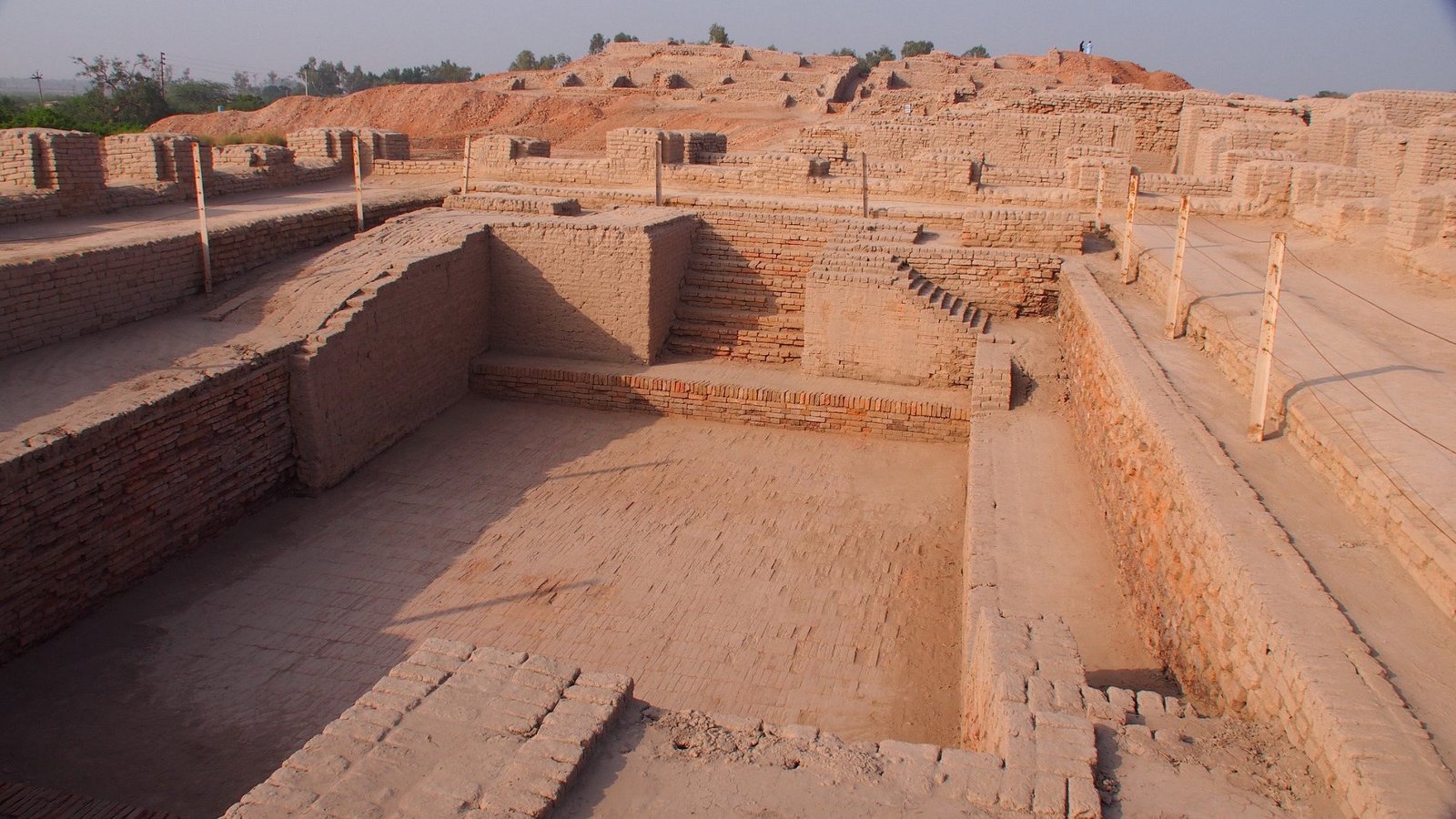
The Great Bath remains the site’s most evocative structure: a large watertight pool measuring roughly 12 metres by 7 metres, constructed from tightly fitted bricks sealed with natural tar. Surrounded by a colonnaded gallery and changing rooms, it is widely believed to have served a ritual or purification purpose — possibly the world’s earliest public water tank. Standing at its edge today, looking down at the dark brick, you can almost feel the weight of the millennia.
Perhaps most intriguing of all is the apparent absence of warfare. Unlike contemporary Mesopotamian cities, Mohenjo-daro has yielded virtually no weapons, no depictions of battles or military leaders, and no evidence of a warrior class. The IVC seems to have been, almost uniquely among ancient civilisations, a society built on trade and civic order rather than conquest. Its standardised weights and measures were used across a trading network spanning from the Arabian Sea coast to the foothills of the Himalayas.
One mystery remains stubbornly unsolved: the Indus script. Thousands of small seals have been recovered from Mohenjo-daro and other IVC sites, each bearing short inscriptions in a pictographic script of around 400 signs. Despite decades of effort by linguists and archaeologists worldwide, it has never been deciphered. We do not know what language the people of Mohenjo-daro spoke, what they called themselves, or what their religion entailed. This silence at the heart of the civilisation only deepens its fascination.
Getting to Mohenjo-daro from the UK
Step 1: Fly to Pakistan
The most practical international gateway for a trip to Mohenjo-daro is Karachi’s Jinnah International Airport (KHI), Pakistan’s largest city and roughly 450km south of the site. Several airlines serve this route from the UK, including Emirates (via Dubai) and Qatar Airways (via Doha), with journey times typically between 14 and 16 hours and return fares from approximately £500–£800 depending on season and booking lead time. Alternatively, fly into Islamabad and connect domestically.
Step 2: Reach Larkana
Larkana is the nearest town of any size to Mohenjo-daro, approximately 25km from the archaeological site. Your options from Karachi include the legendary Khyber Mail train service, one of Pakistan’s great rail journeys, which covers the route in around eight hours and deposits you in the heart of Sindh province. Alternatively, fly from Karachi to Sukkur (the nearest city with a larger airport, around 90km from the site) and hire a car from there.
Step 3: Mohenjo-daro Airport
The site actually has its own small airport — Mohenjo-daro Airport (IATA: MJD) — served by Pakistan International Airlines (PIA) on limited schedules from Karachi. If this service is running when you visit, it dramatically simplifies access, cutting a long overland journey to a short flight of around an hour. Check PIA’s current timetables carefully in advance, as schedules are subject to change and flights can be infrequent.
Whichever route you take, we strongly recommend booking with a specialist operator who knows the logistics on the ground. Passage to Pakistan can handle transfers, accommodation, and guiding throughout, so you can focus on the archaeology rather than the logistics.
When to Visit Mohenjo-daro
Timing your visit correctly is not optional — it is essential. Sindh province experiences some of Pakistan’s most extreme temperatures, and the summer months are genuinely dangerous for outdoor exploration.
The best time to visit is November through February, when daytime temperatures hover pleasantly between 15°C and 25°C — ideal for spending several hours walking a large, exposed archaeological site. December and January are peak season for domestic visitors and the most comfortable months for foreigners.
Avoid May through September entirely. Sindh’s summer temperatures regularly reach 40–50°C, and the Great Bath becomes rather less inviting when you’re in danger of heatstroke. Even in the cooler months, plan to arrive at the site as soon as it opens in the morning — by midday even winter sunshine can be fierce, and the site has limited shade.
What to See at Mohenjo-daro
Mohenjo-daro is divided into two main zones: the elevated Citadel Mound (also called the Stupa Mound or DK Area), where the city’s major public buildings are located, and the Lower Town, which preserves the residential and commercial districts. Allow at least three to four hours to do justice to both, including time at the on-site museum.
The Great Bath
The undisputed centrepiece of the site. This large, watertight pool — approximately 12m by 7m and nearly 3m deep — was constructed with extraordinary precision, its bricks set in gypsum mortar and the whole structure sealed with natural bitumen to prevent leakage. Galleries ran along the sides, and small changing rooms opened off them. Scholars believe it served a ritual cleansing or purification purpose, possibly for a priestly class. It is, in essence, the world’s oldest known public bath.
The Lower Town
This is where the population actually lived and worked, and it is in some ways more moving than the grand public buildings. Walking the remnants of the residential streets, you can make out the outlines of individual houses — their entrances set back from the street, their private bathrooms connected to the city’s drainage system, their private wells. The civic order implied by this layout is remarkable. People here had running water when most of the ancient world did not.
The Granary
A large multi-roomed structure near the Citadel Mound, widely interpreted as a granary or storage facility for the city’s food supply. Its scale suggests sophisticated management of agricultural surplus — the kind of resource control that underpins complex urban societies.
The Assembly Hall
A multi-pillared hall that may have served as a civic or ceremonial gathering place — possibly the world’s oldest parliament, though we cannot know its function with certainty. Its very existence implies a public or political life that required dedicated space.
The Buddhist Stupa
A later Buddhist stupa, built atop the Citadel Mound centuries after the IVC had disappeared, accounts for why the IVC ruins beneath were preserved — builders used them as foundations. It is a reminder that sacred landscapes accumulate meaning across millennia.
The Site Museum
Do not skip the on-site museum, which houses an excellent collection of IVC artefacts: inscribed seals, painted pottery, bronze tools, jewellery, children’s toys, and gaming pieces. It provides essential context for the ruins you have just walked through and brings the people of Mohenjo-daro into focus as a human community rather than an abstract archaeological category.
The Museum Collection: Artefacts That Survived Four Thousand Years
The objects recovered from Mohenjo-daro are extraordinary — not in their grandeur (there is no gold of Tutankhamun here) but in what they reveal about daily life. Among the most significant:
The Priest-King — a small steatite sculpture of a bearded, robed figure whose gaze carries an authority that transcends four thousand years. The original is in the National Museum in Karachi; the site museum holds a replica. It is one of the most reproduced images in South Asian art history, yet seeing it in context, near where it was found, is a different experience entirely.
The Dancing Girl — a small bronze figurine of a young woman, hand on hip, head tilted back with casual confidence. Cast using the lost-wax technique, it is a masterpiece of Bronze Age metalworking. The original is now in the National Museum in New Delhi, having been taken there before Partition; its absence from Mohenjo-daro is a sore point in Pakistani archaeological circles.
The Indus seals — hundreds of small square or rectangular seals carved from steatite, each bearing pictographic inscriptions and often an animal image (bull, elephant, rhinoceros, unicorn-like creature). They were likely used by merchants to stamp goods. Their script remains undeciphered. Every archaeologist and linguist who has tried has failed. Perhaps you will do better.
National Museum Karachi: The Essential Companion Visit
If your journey to Mohenjo-daro begins or ends in Karachi — and it most likely will — build in a visit to the National Museum of Pakistan. Its Indus Valley Civilisation galleries house the finest collection of Mohenjo-daro artefacts in the world, including the original Priest-King sculpture and extensive displays of seals, pottery, weights, and figurines. Allow two to three hours, and ideally visit before the site itself — the museum provides magnificent context for what you are about to see.
Practical Visitor Information
The site is open daily from approximately 8am to 5pm. Arrive at opening — not only to beat the heat but to have the ruins to yourself in the early light, which is also the best time for photography.
Entry fees for foreign visitors are approximately PKR 500 (verify the current rate before your visit, as these change). This is excellent value for one of the most significant archaeological sites on earth.
Hire a guide from the gate. The difference between wandering a field of brick stumps and understanding what you are looking at is the difference a good guide makes. The guides at Mohenjo-daro are knowledgeable and passionate about the site; their insight will repay the modest fee many times over.
Come equipped: a hat, high-factor sunscreen, comfortable walking shoes with good grip, and plenty of water. Food and drink options at the site are limited, so bring snacks. Photography is permitted throughout — bring a wide-angle lens for the Great Bath and the sweeping views from the Citadel Mound.
Budget three to four hours for a thorough visit, including the museum.
Where to Stay Near Mohenjo-daro
Accommodation options near Mohenjo-daro are modest. Larkana has several basic hotels that are perfectly adequate for a night; book in advance, particularly in the November–February peak season. For more comfortable options, Sukkur, around 90km away, offers a wider choice. Many visitors choose to base themselves in Karachi and make Mohenjo-daro a long but feasible day trip, particularly if using the MJD airport — though this leaves little time to linger.
Passage to Pakistan can arrange accommodation at all levels, from basic local guesthouses to more comfortable options in Sukkur or Karachi, matched to your budget and preferences.
Combining Mohenjo-daro with Other Sites
Makli Necropolis and Thatta
Roughly two hours from Karachi, the Makli Necropolis is another UNESCO World Heritage Site and one of the largest Islamic graveyards in the world — a vast, haunting landscape of Mughal, Tarkhan, and Samma-era tombs spanning several centuries and tens of thousands of graves. The nearby town of Thatta has the magnificent Shah Jahan Mosque, built on the orders of the Mughal emperor in the 17th century. Both sites sit on the road between Karachi and Mohenjo-daro and combine naturally into a multi-day tour of Sindh’s extraordinary heritage.
Harappa
The other great IVC city, Harappa, lies in Punjab province near the town of Sahiwal — a longer journey from Mohenjo-daro but deeply rewarding for serious students of the civilisation. Seeing both sites reveals the IVC’s remarkable consistency: the same town planning, the same standardised bricks, the same script, separated by hundreds of kilometres. The Harappa Archaeological Museum has a fine collection of its own.
A Note on Conservation
Mohenjo-daro is under threat. Rising groundwater — partly a consequence of irrigation schemes in Sindh — is eroding the ancient brickwork from below, while salt crystallisation is attacking it from above. The site has been on UNESCO’s endangered list, and the clock is not on its side. Some archaeologists believe that sections of the Lower Town, if not properly protected, may not survive another century of exposure.
This is a reason to visit sooner rather than later — and it is a reason why responsible tourism matters. Entrance fees and tourism revenue support conservation work. By visiting Mohenjo-daro, you are, in a small way, contributing to its survival.
Visit Mohenjo-daro with Passage to Pakistan
Mohenjo-daro is not a site for impulse visits. The logistics — getting to Sindh, finding reliable transport, securing knowledgeable guiding, combining it with other sites — reward careful planning. At Passage to Pakistan, we specialise in exactly this kind of heritage travel: itineraries that take you deep into Pakistan’s extraordinary archaeological and cultural landscape, with expert local guides, comfortable transport, and the logistical confidence that lets you focus entirely on the history.
We offer dedicated Indus Valley Civilisation tours combining Mohenjo-daro with the Makli Necropolis, Karachi’s National Museum, and other Sindh heritage sites — as well as wider Pakistan heritage itineraries that take in Harappa, the Gandhara Buddhist sites of Khyber Pakhtunkhwa, and the Mughal monuments of Lahore. Whatever draws you to Pakistan’s past, we can build an itinerary around it.
Contact our team to discuss your Mohenjo-daro travel plans, or browse our heritage tours for inspiration.
The people of Mohenjo-daro built their city more than four thousand years ago. They planned its streets, constructed their drains, filled their bath, and carved their names — or something — into small stone seals we cannot read. Then, around 1900 BCE, they disappeared. We do not know why. Walking among what they left behind, with that question hanging in the air, is one of the most quietly extraordinary experiences in all of travel.
Mohenjo-daro FAQs
Q: What is Mohenjo-daro and why is it important?
A: Mohenjo-daro is one of the worlds earliest and best-preserved urban settlements, built around 2500 BCE by the Indus Valley Civilisation. It is a UNESCO World Heritage Site and reveals advanced urban planning with grid streets, sewage systems, and multi-storey buildings predating Rome by 2,000 years.
Q: Where is Mohenjo-daro located?
A: Mohenjo-daro is located in Larkana district, Sindh province, southern Pakistan, about 510km from Karachi. The site sits on the right bank of the Indus River.
Q: How do I get to Mohenjo-daro?
A: Fly from Islamabad or Karachi to Moenjo-daro Airport (MJD), which has connections from Karachi. Alternatively, take a train or bus to Larkana city and hire a taxi to the site (approximately 30km from Larkana).
Q: What is the best time to visit Mohenjo-daro?
A: October to February is ideal when temperatures in Sindh are manageable (15 to 28C). Summer temperatures exceed 45C making visits very uncomfortable. The on-site museum is open daily.
Q: How long does it take to tour Mohenjo-daro?
A: Allow 2 to 3 hours to walk the main excavated areas including the Great Bath, the Granary mound, the Lower Town, and the site museum. A half-day visit from Larkana is comfortably achievable.
Q: Can I combine Mohenjo-daro with other UNESCO sites in Pakistan?
A: Yes. Combine Mohenjo-daro with Makli Necropolis (a 4-hour drive), Thatta, and potentially Taxila (north Pakistan) in a broader Pakistan ancient history itinerary spanning Sindh and Punjab.