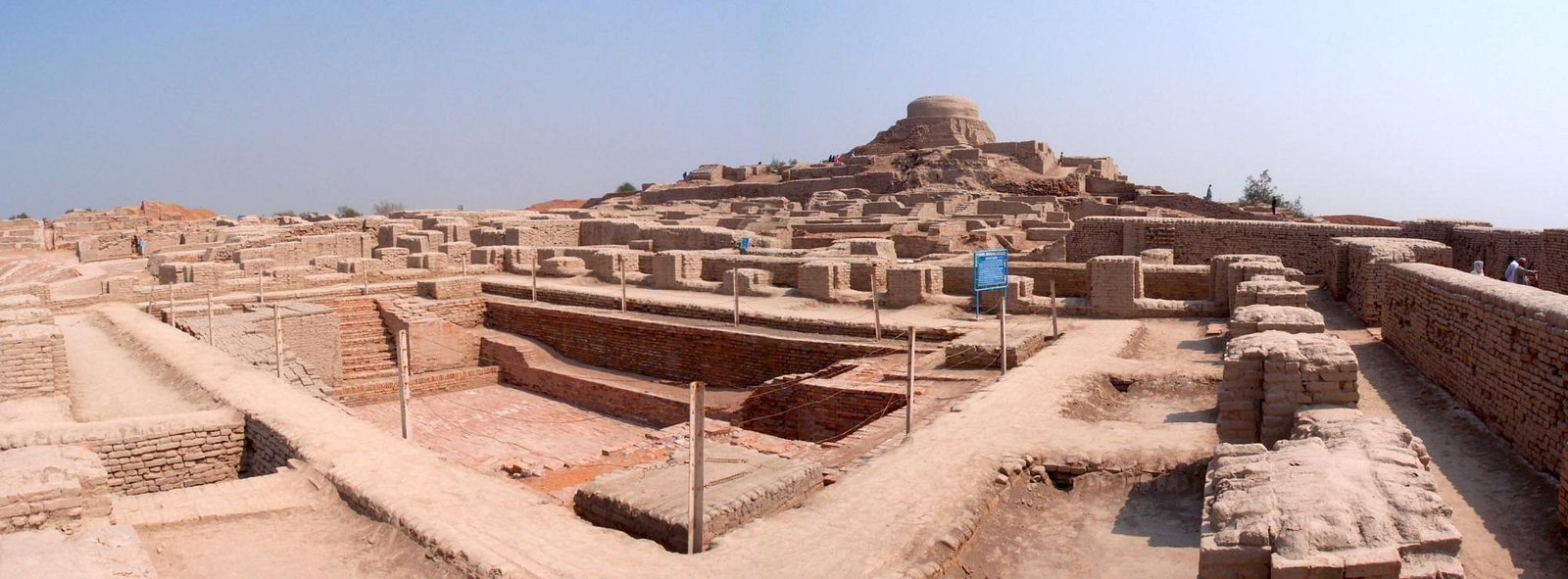
Long before the Roman Empire rose, or even ancient Greece flourished, a sophisticated urban civilisation thrived along the banks of the Indus River. Pakistan is home to some of the world’s oldest cities, most awe-inspiring archaeological sites, and a layered history spanning 5,000 years — from the Bronze Age Indus Valley Civilisation to Buddhist Gandhara, Mughal grandeur, and Sikh heritage. For UK travellers with a passion for history and archaeology, Pakistan is one of the world’s great undiscovered destinations: a place where you can stand in a Bronze Age city, walk a Silk Road trading route, and explore a Mughal capital, all within a single journey.
Why Pakistan is a World-Class History Destination
Most British travellers instinctively reach for Egypt, India, or Greece when they think of ancient civilisations. Pakistan rarely makes that shortlist — which is precisely why it should. The country holds seven UNESCO World Heritage Sites, including Mohenjo-daro, Taxila, the Lahore Fort complex, Rohtas Fort, the Makli Necropolis, the Shalimar Gardens, and Takht-i-Bahi. That tally rivals many of the world’s most celebrated history destinations.
What sets Pakistan apart is the sheer depth and variety of its historical record. The Indus Valley Civilisation (3300–1700 BCE) was contemporary with ancient Egypt and Mesopotamia, and ranks as one of four great early civilisations. Centuries later, the Buddhist Gandharan kingdom (1st–5th century CE) produced some of the most extraordinary religious art ever made, fusing Hellenistic and Buddhist traditions along the Silk Road. Then came the Mughals, who made Lahore one of the jewels of their empire, and the British, who left their own colonial imprint across the subcontinent.
Perhaps most importantly, many of these sites are virtually empty of tourists. Unlike the queues at Giza or the Colosseum, you can stand at Mohenjo-daro — one of the greatest archaeological sites on earth — with almost no one else around. For travellers who value depth of experience over social media crowds, that quiet immersion in history is extraordinary.
The Indus Valley Civilisation: The Ancient World’s Urban Pioneers
Between roughly 3300 and 1700 BCE, an extraordinary urban civilisation developed across the floodplains of the Indus River and its tributaries. At its height, the Indus Valley Civilisation covered an area larger than ancient Egypt and Mesopotamia combined, encompassing hundreds of cities and towns across what is now Pakistan and north-western India.
What makes it remarkable — and in some ways unsettling — is how advanced it was. Cities like Mohenjo-daro and Harappa were built on a grid plan, with straight streets, standardised brick sizes, sophisticated drainage systems, and indoor plumbing. Residents had access to covered sewers at a time when Londoners were still millennia away from that luxury. Standardised weights and measures suggest a regulated economy and long-distance trade networks stretching from the Persian Gulf to Central Asia.
Mohenjo-daro
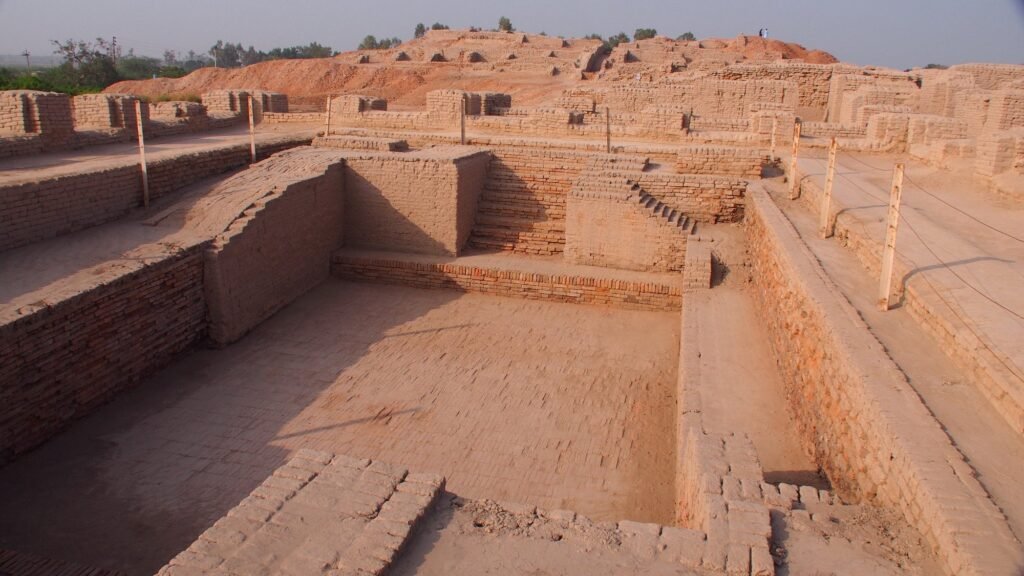
Located in Sindh, Mohenjo-daro is the most impressive Indus Valley site open to visitors and a UNESCO World Heritage Site. Excavated from the 1920s onwards, the ruins reveal a city that once housed an estimated 40,000 people. The Great Bath — a large, watertight public pool at the centre of the upper citadel — is particularly striking: it predates the Roman baths by over 2,000 years. Walking its brick-lined streets, it is genuinely difficult not to feel a sense of awe at the ingenuity of people who built this more than four millennia ago.
Harappa
In Punjab’s Sahiwal district, Harappa gave the civilisation its modern name. The site is less visually dramatic than Mohenjo-daro — much was damaged by 19th-century railway builders who used its bricks as ballast — but the on-site museum is excellent, and it was here, in the 1920s, that archaeologists first realised they had uncovered something momentous. The Indus script found on thousands of stamp seals remains undeciphered to this day, one of archaeology’s great enduring mysteries.
For visitors to Karachi, the National Museum holds the finest collection of Indus Valley artefacts in the world, including the famous figurines, seals, and bronze statuettes that bring this vanished civilisation to life.
Buddhist Gandhara: Where Greece Met the Buddha
Several centuries after the Indus Valley Civilisation declined, a new and equally remarkable culture emerged in the valleys of what is now north-western Pakistan. The Gandharan civilisation (roughly 1st–5th century CE) developed at the crossroads of the Silk Road, where trade routes from Rome, Persia, India, and China converged. The result was a unique artistic and religious fusion that changed the history of world art.
It was here, in the workshops of Taxila, Swat, and the Peshawar Valley, that artists first depicted the Buddha in human form. Before Gandhara, Buddhist art represented the Enlightened One only symbolically — through footprints, an empty throne, or a Bodhi tree. The Gandharan sculptors, drawing on the Hellenistic tradition introduced by Alexander the Great’s campaigns in the 4th century BCE, gave the Buddha a face. They sculpted him draped in a toga-like robe, with wavy Greek hair and serene Mediterranean features — an image that then spread across Asia and became the template for Buddhist iconography from Japan to Sri Lanka.
Taxila
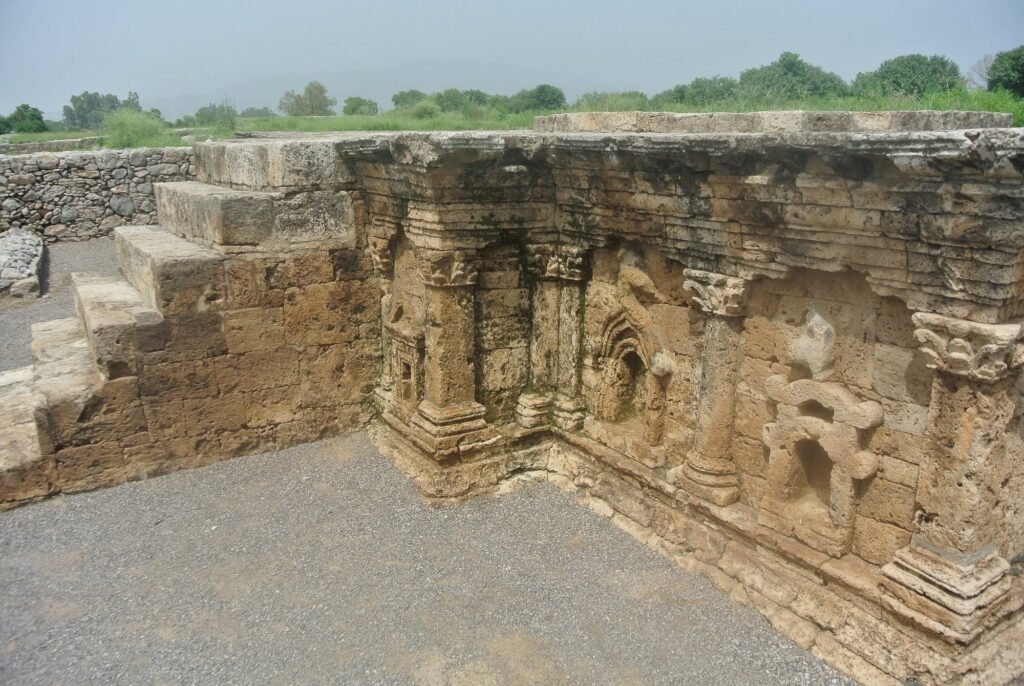
Taxila is the centrepiece of any Gandhara itinerary and a UNESCO World Heritage Site. The site actually encompasses several distinct cities built across different eras, along with dozens of Buddhist stupas and monasteries spread across the surrounding hills. The Taxila Museum is among the finest in South Asia, with room after room of exquisite schist sculptures, coins, jewellery, and everyday objects. Allow a full day here; the ruins repay slow exploration.
Takht-i-Bahi and the Swat Valley
The monastery complex of Takht-i-Bahi, perched dramatically on a hilltop in Khyber Pakhtunkhwa, is another UNESCO site and one of the most visually striking in the country. Dating from the 1st century CE, it was continuously occupied until the 7th century and remains remarkably well preserved. The Swat Valley further north is dotted with stupas, rock carvings, and archaeological sites, and the Swat Museum in Saidu Sharif holds a superb collection of Gandharan art. Peshawar Museum, often overlooked, contains treasures equal to anything on the subcontinent.
Lahore: The Mughal Empire’s Greatest City
If the Indus Valley Civilisation represents Pakistan’s ancient past and Gandhara its classical era, Lahore is its medieval and early modern glory. Under the Mughals — arguably the most accomplished dynasty ever to rule the Indian subcontinent — Lahore became one of the world’s great imperial capitals, a city of gardens, mosques, tombs, and forts that rivalled contemporary Istanbul or Paris in sophistication and grandeur.
Lahore Fort (Shahi Qila)
The Lahore Fort is a UNESCO World Heritage Site and the centrepiece of any visit. Successive Mughal emperors — Akbar, Jahangir, Shah Jahan, Aurangzeb — each added buildings, creating a complex that spans the entire arc of Mughal architecture. The Sheesh Mahal (Palace of Mirrors), encrusted with thousands of inlaid mirror fragments, is jaw-dropping. The Diwan-i-Aam (Hall of Public Audience), the Moti Masjid (Pearl Mosque), and the painted frescoes of the Naulakha pavilion are equally remarkable.
Shalimar Gardens
Built by Emperor Shah Jahan in 1641 — the same emperor who commissioned the Taj Mahal — the Shalimar Gardens are a masterpiece of Mughal garden design and a second UNESCO listing for Lahore. Arranged across three terraces with hundreds of fountains, ornamental pools, and pavilions, the gardens once provided a summer retreat for the imperial court. They remain a place of genuine beauty and tranquillity.
Badshahi Mosque and the Walled City
Commissioned by Emperor Aurangzeb in 1671, the Badshahi Mosque was for centuries the world’s largest mosque and remains one of its most magnificent. Its vast red sandstone courtyard holds 100,000 worshippers. Directly across from the fort, it forms a ceremonial ensemble of breathtaking scale.
The Walled City of Lahore, spreading out behind the mosque, is a labyrinth of medieval streets, Mughal havelis (mansions), Sikh-era temples, and colonial-era buildings — a city built in layers, each century visible if you know where to look. The nearby Shahdara Bagh gardens contain the tombs of Emperor Jahangir and his empress Nur Jahan, both worth visiting for their tilework and setting alone.
Other Key Historical Sites
Rohtas Fort
Built in 1541 by the Afghan ruler Sher Shah Suri — who famously defeated the Mughal Emperor Humayun and ruled the subcontinent for a brief but influential decade — Rohtas Fort is one of the finest military fortifications in South Asia and a UNESCO World Heritage Site. Its massive walls, stretching over four kilometres, incorporate twelve gateways of extraordinary architectural quality. Unlike many forts, Rohtas sees very few tourists, lending it an atmosphere of genuine discovery.
Makli Necropolis

Near Thatta in Sindh, the Makli Necropolis is one of the largest burial grounds in the world, containing an estimated half a million graves spanning the 14th to 18th centuries. The tombs of the Sindhi rulers and nobles are remarkable: carved from local stone and decorated with geometric patterns, Quranic calligraphy, and glazed tiles, they represent a distinctive regional funerary tradition that has no real parallel elsewhere in the Islamic world. Makli is a UNESCO World Heritage Site and profoundly moving to visit.
Multan: City of Saints
One of the oldest continuously inhabited cities in South Asia — some scholars place its origins over 4,000 years ago — Multan is famous as a centre of Sufi Islam and for the blue glazed tilework that has been produced here for centuries. The Shrine of Shah Rukn-e-Alam, built in the 14th century, is one of the most beautiful examples of Tughlaq architecture in existence, its soaring brick dome decorated with intricate geometric patterns. Multan rewards visitors who venture off the standard itinerary.
Peshawar and the Khyber Pass
Peshawar is one of the oldest cities in Asia, continuously inhabited for at least 2,500 years and a major node on the ancient Silk Road. The Qissa Khwani Bazaar — the Street of Storytellers — was once the great crossroads of Central Asia, where merchants, soldiers, and travellers from across the known world converged. Today it remains a bustling, atmospheric market. Above the city, the Khyber Pass was crossed by Alexander the Great, Babur, and countless others; the views from its heights into Afghanistan are as dramatic as the history is layered.
Suggested Itineraries for UK History Travellers
10-Day Ancient Pakistan Explorer
Fly into Lahore and spend two days exploring the Mughal city: the Fort, Shalimar Gardens, Badshahi Mosque, and the Walled City. On day three, take a day trip to Taxila, then continue to Peshawar for a day in the Khyber Pass region and the city’s museums. Fly from Islamabad to Karachi and use the city as a base for a day trip to Mohenjo-daro, then drive to Thatta to visit the Makli Necropolis before a final day in Karachi at the National Museum.
7-Day Punjab Heritage
Three days in Lahore followed by a day trip to Rohtas Fort, then overnight at Harappa before continuing south to Multan for two nights to explore the city of saints. Fly home from Multan. This compact itinerary focuses on Punjab’s extraordinary concentration of historical sites.
14-Day Complete Ancient Pakistan
For those who want the full picture: begin with three days in Lahore, then Taxila (one day), Peshawar and the Khyber Pass (two days), and Swat Valley with Takht-i-Bahi and Gandhara sites (two days). Fly south to Karachi, visit Mohenjo-daro (one day) and Makli/Thatta (one day), spend a day in Karachi at the National Museum, then finish with two nights in the Hunza Valley for a glimpse of the mountains that frame the ancient Silk Road. Fly home via Islamabad.
Practical Information for UK Travellers
Best time to visit: October to March is ideal for Sindh and Punjab, where summer temperatures exceed 45°C. The Gandhara sites in the north are pleasant from April to October.
Visa: UK citizens can apply for a Pakistani eVisa at visa.nadra.gov.pk. The process is straightforward and costs approximately £35–45. Allow a few days for processing.
Flights: Direct and one-stop flights from London to Lahore, Islamabad, and Karachi are offered by Emirates (via Dubai), Qatar Airways (via Doha), and Turkish Airlines (via Istanbul). Flying times are typically 8–12 hours with a connection.
On the ground: All the major archaeological sites require sturdy, comfortable footwear, sun protection, and plenty of water — particularly in Sindh, where shade is scarce. Entry fees for UNESCO sites are nominal by UK standards, typically between PKR 200 and 2,000. English is widely spoken at historical sites, and guides are available at most of the major locations.
Safety: The popular tourist routes in Punjab, Sindh, and the northern valleys are well-established and safe for international visitors. Your tour operator will advise on any current local considerations when planning your itinerary.
Why Book with Passage to Pakistan
Visiting Pakistan’s historical sites independently is possible, but the depth of experience you gain with expert guidance is transformative. At Passage to Pakistan, our guides don’t just point at ruins — they make the history live. They know which carved detail at Taxila shows Greek influence, which neighbourhood of the Walled City retains its Mughal street pattern, and which viewpoint at Mohenjo-daro gives you the best sense of how the city once looked.
For those with a serious interest in archaeology and ancient history, we can arrange specialist tours led by archaeologists and historians, giving you access to expert knowledge that no guidebook can replicate. We handle all logistics — transport, accommodation, entry permits, and guide arrangements — so you can focus entirely on the experience.
All our itineraries are tailor-made. Whether you want a focused two-week deep dive into the Indus Valley Civilisation, a grand tour spanning five millennia, or a private group trip for fellow history enthusiasts, we design the journey around what matters most to you.
Pakistan’s 5,000 years of history are waiting. Very few people from the UK have seen them. You could be one of the first.
Ready to explore one of the world’s great undiscovered history destinations? Enquire about our Ancient Pakistan tours today and let us design your perfect historical journey.