Hidden in Pakistan’s remote north-west, where the Hindu Kush mountains meet ancient civilisations, Chitral and the Kalash Valley offer one of the world’s most extraordinary travel experiences. For UK travellers seeking something genuinely off the beaten path, this corner of Khyber Pakhtunkhwa delivers jaw-dropping scenery, living history, and cultural encounters you simply cannot find anywhere else on earth.
This complete 2026 guide covers everything British visitors need to know: when to go, how to get there, what to see, how to respect Kalash customs, and how to book a guided tour from the UK.
Why Chitral is Special: Mountains, Culture and Ancient Traditions
Chitral sits at 1,500 metres in a broad valley carved by the Chitral River, surrounded on all sides by the towering peaks of the Hindu Kush. This is one of the most geographically dramatic districts in Pakistan — the nearby Tirich Mir, at 7,708 metres, is the highest peak entirely within Pakistan, and its white flanks dominate the skyline on clear days.
What sets Chitral apart from Pakistan’s other mountain destinations is not simply its landscapes but its people. The Chitrali people are a blend of Dardic, Nuristani and other influences, with a tradition of hospitality that feels almost mythological. The town of Chitral itself — often called “the city of pearls” by local poets — is a relaxed, unhurried place where traders, shepherds and schoolchildren share the main bazaar beneath peaks that dwarf everything.
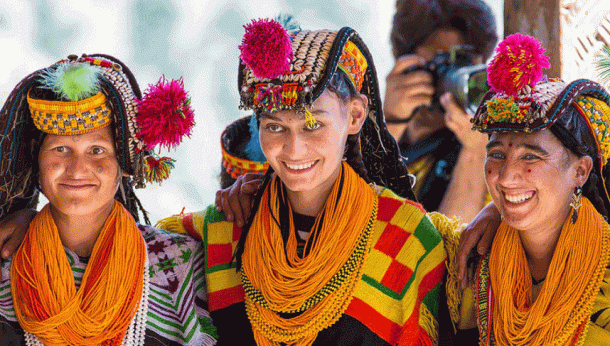
Most compelling of all, however, are the Kalash people. Living in three remote valleys south of Chitral town, the Kalash are a small ethno-religious minority of around 4,000 people who have maintained their pre-Islamic belief system, language, music and festivals for millennia. Scholars debate their origins — some claim descent from Alexander the Great’s armies, others trace them to central Asian migrations — but what is undeniable is that the Kalash culture is unique on earth. Their brightly coloured dress, elaborate headdresses, communal festivals and wooden temples represent a living heritage that survived precisely because of Chitral’s remoteness.
For UK travellers, reaching Chitral feels like a genuine expedition. The reward is an encounter with mountain cultures that have changed remarkably little over centuries — combined with some of the most spectacular trekking and scenery in Asia.
Best Time to Visit Chitral and the Kalash Valley in 2026
Timing your visit wisely makes an enormous difference to what you experience in Chitral.
May — Chilam Joshi Festival: The single best time to visit the Kalash valleys is during the Chilam Joshi spring festival, held each May (typically around 13–16 May in 2026). This is the Kalash celebration of spring’s arrival: three days of music, dance, singing and feasting in Bumburet Valley. Women dress in their finest embroidered robes and elaborate cowrie-shell headdresses; men play flutes and drums; the valleys fill with colour and sound. This festival is the most photographed and most visited Kalash event, and sharing it with the community is a genuinely moving experience. Book early — May sees the most visitors and accommodation fills quickly.
August — Uchaw Festival: The late-summer Uchaw festival (usually mid-August) marks the harvest of corn. The atmosphere is more intimate than Chilam Joshi, with fewer outside visitors, making it a good choice if you prefer a quieter, more personal encounter.
September – October: For trekking and sightseeing without festivals, September and October offer the most reliable weather. Days are warm and clear, nights cool. The landscapes are golden and the passes are still open, including Shandur Pass. This is the ideal window for those combining Chitral with longer treks in the region.
Winter (November–March): Snow closes many roads and passes, including the Lowari Tunnel approach at times. Not recommended unless you are a very experienced cold-weather traveller with specialist local support.
Getting There: Flights, Road and the Lowari Tunnel
Chitral is remote by any measure, but reaching it from the UK is more straightforward than you might expect once you are in Pakistan.
International flights to Pakistan: UK travellers fly into Islamabad International Airport (ISB), which has direct flights from London Heathrow with Pakistan International Airlines (PIA) and British Airways, as well as connections via Dubai, Doha and Abu Dhabi with Emirates, Qatar Airways and Etihad. Flight times from London to Islamabad run roughly seven to eight hours direct, or ten to twelve hours with a connection. Book at least three months in advance for best fares in the festival season.
Fly Islamabad to Chitral: PIA operates flights between Islamabad and Chitral Airport (CJL). The route is scenic — the flight path skirts the Hindukush — but subject to cancellation in poor weather, as Chitral’s mountain airstrip is affected by cloud and wind. If flying, always allow at least one extra day in Islamabad in case of delays. Flight time is approximately 50 minutes.
Drive via the Lowari Tunnel: The opening of the Lowari Tunnel in 2017 transformed overland access to Chitral. The tunnel (10.3 km) runs beneath the 3,118-metre Lowari Pass, keeping the main road open year-round. The overland journey from Islamabad via Dir and the tunnel takes around eight to ten hours depending on conditions. The drive is dramatic, passing through Dir district, climbing through pine-forested hillsides and emerging into the broad Chitral Valley. Many tour operators, including Passage to Pakistan, arrange private vehicle transfers so you can stop at viewpoints and villages en route.
Onward to the Kalash valleys: From Chitral town, the Kalash valleys of Bumburet, Rumbur and Birir are reached by jeep road. Bumburet, the largest and most visited, is about 30 km south of Chitral; the journey takes roughly 60 to 90 minutes on the unpaved mountain track. Local jeep hire is available in Chitral town, or your tour guide will arrange transfers as part of the itinerary.
What to See: Highlights of a Chitral Tour
Chitral Fort and the Royal Family
Chitral Fort occupies a commanding position above the Chitral River and is the historic seat of the Mehtars (rulers) of Chitral. The current fort dates mainly from the nineteenth century and is famous as the site of the 1895 Siege of Chitral, when a British garrison and allied local forces held out for 46 days against an attacking force — one of the defining episodes of the Great Game. Today part of the fort serves as the residence of the Chitral royal family. Visitors can tour the outer areas, admire the carved wooden architecture and soak up the history. The views of the river and surrounding peaks from the fort walls are outstanding.
Chitral Bazaar
Chitral’s main bazaar is a lively, authentic market where you can browse carved wooden items, woollen Chitrali caps (pakol), hand-embroidered textiles and locally produced honey. The pace is unhurried; shopkeepers are invariably welcoming and curious about foreign visitors. Allow an hour to wander and have tea in one of the small chai houses.
The Three Kalash Valleys: Bumburet, Rumbur and Birir
The three Kalash valleys — Bumburet (Mumoret), Rumbur and Birir — run roughly parallel, separated by forested ridges, and each has its own distinct character.
Bumburet is the most accessible and most visited. The main valley floor is dotted with Kalash villages, wooden shrines, terraced fields and walnut orchards. The largest village, Anish, has a small museum and is the focus of the Chilam Joshi festival. Bumburet also has the most guesthouses, making it the best base for multi-day visits.
Rumbur, reached by a side road north of Bumburet, is quieter and more pristine. Many travellers prefer its atmosphere — fewer visitors, more opportunity for genuine exchanges with Kalash families, and spectacular surrounding peaks. The traditional wooden buildings here are particularly well-preserved.
Birir, the most southerly valley and separated from Bumburet by a mountain ridge, is the most traditional of the three. With fewer outside visitors than Bumburet, Birir communities have maintained stronger adherence to old customs. Reaching Birir requires a separate jeep journey from Chitral town. The effort is worthwhile for travellers seeking the most authentic Kalash experience.
Shandur Pass
At 3,734 metres, Shandur Pass is the “Roof of the World” according to local lore — a high-altitude plateau that forms the boundary between Chitral and Gilgit-Baltistan. It is famous for the annual Shandur Polo Festival, held each July, when teams from Chitral and Gilgit play the world’s highest polo match on the plateau’s natural ground. Even outside festival time, driving or trekking to Shandur is a magnificent experience: the plateau lakes shimmer at altitude, yak herders camp in felt tents, and the view of peaks in every direction is unforgettable. The drive from Chitral to Shandur takes around four to five hours on a rough mountain road.
Garam Chashma Hot Springs
About 45 km north-west of Chitral, the natural hot springs at Garam Chashma have drawn visitors for centuries. The sulphurous waters are said to have medicinal properties, and local families bathe here. The drive up the river valley to Garam Chashma is beautiful in itself, and the springs make a relaxing half-day excursion from Chitral town.
The Kalash People: Culture, Customs and Photography
The Kalash are the most photographed minority in Pakistan, and with good reason: their costumes, rituals and festivals are visually extraordinary. But the attention brings responsibilities, and UK travellers should approach the Kalash with the same thoughtfulness they would bring to any community whose lives are very different from their own.
Religion and sacred spaces: The Kalash religion — sometimes called Kalash shamanism or Kalasha — involves worship of a pantheon of gods and spirits, with rituals tied to the agricultural calendar. The “Jestakhan” (women’s house) and certain shrines are sacred and off-limits to outsiders. Always follow the guidance of your local guide or community members about which areas are restricted.
Dress: Kalash women wear distinctive black robes embroidered with cowrie shells and colourful beads, topped with elaborate headdresses decorated with buttons, beads and feathers. These are not costumes for tourists — they are everyday dress and ceremonial wear that women have worn for generations. Admire them, ask questions if welcomed, but do not touch or handle the garments without explicit invitation.
Photography etiquette: Always ask permission before photographing individuals. During festivals, photography is generally welcomed, but pointing a camera at someone in a private moment, inside a home, or near a sacred site without permission is intrusive. Some older Kalash women prefer not to be photographed; always accept a refusal graciously. Paying for photographs is not standard practice in Kalash communities and can feel transactional; a genuine, respectful interaction is worth infinitely more than a posed shot.
Women’s houses (Bashali): The Bashali is a secluded space for women during menstruation and childbirth. Outsiders — especially men — should never approach or enter the Bashali.
Alcohol and social norms: Unlike the majority Muslim population, the Kalash do not prohibit alcohol, and locally-made wine is part of festival culture. Exercise discretion and always follow your guide’s advice on appropriate social conduct.
Environmental responsibility: The Kalash valleys are facing growing pressure from tourism. Take all litter out with you, use guesthouses that dispose of waste responsibly, and avoid buying items made from local wildlife or protected plants.
Accommodation Options in Chitral and the Kalash Valleys
Chitral town has a range of accommodation from comfortable mid-range hotels to simple guesthouses. The best-established options in town include the Hindukush Heights Hotel, which offers comfortable rooms with mountain views and reliable hot water — a significant advantage after long days of travel. For budget travellers, the PTDC Motel and several local guesthouses provide clean, basic accommodation at modest rates.
In the Kalash valleys, accommodation is simpler. Bumburet has the most guesthouses, ranging from family-run places with basic facilities to slightly more comfortable lodges. Rumbur and Birir have fewer options. During the Chilam Joshi festival, accommodation fills entirely — booking months in advance is not an exaggeration. Sleeping under walnut trees on a charpoy (rope bed) in a family compound, with the sound of drums carrying from the festival ground, is one of those travel memories that stays with you for a lifetime.
It is worth noting that many travellers on guided tours stay in Chitral town and make day trips into the Kalash valleys, returning to town each evening. This reduces pressure on limited valley accommodation and gives you the option of better facilities at the end of each day. For the festival period, however, spending at least one night in Bumburet is strongly recommended for the full atmosphere.
Tour Packages from the UK: Visiting Chitral with Passage to Pakistan
Independent travel to Chitral is possible but challenging: the region’s infrastructure, the complexity of local transport, and the importance of having a culturally knowledgeable guide all make a guided tour the right choice for most UK travellers visiting for the first time.
Passage to Pakistan specialises in small-group and private tours to northern Pakistan for British travellers. Our Chitral and Kalash Valley itineraries are designed to make the most of the festival calendar, combine well with Hunza and Gilgit-Baltistan if you want a broader northern Pakistan journey, and provide the expertise needed to make your Kalash encounter as respectful and memorable as possible.
Typical tour structures include:
- 7-day Chitral & Kalash Focus: Fly Islamabad–Chitral, three to four days in and around the Kalash valleys timed for Chilam Joshi (May) or Uchaw (August), day trip to Shandur Pass, return to Islamabad overland via the Lowari Tunnel.
- 14-day Northern Pakistan Grand Tour: Combines Chitral and the Kalash valleys with Hunza, Karimabad and the Karakoram Highway, with options for acclimatisation treks to Rakaposhi basecamp or Passu Cones.
- Custom Private Tours: Passage to Pakistan can build a bespoke itinerary around your dates, interests and fitness level.
All our Chitral tours include private or shared vehicle transfers, accommodation, the services of an experienced English-speaking guide, and full logistical support. View our current Pakistan tour packages for 2026 availability and pricing.
Safety and Visa Information for UK Travellers
Visa
UK citizens require a visa to visit Pakistan. The good news is that Pakistan operates an e-visa system that makes the process straightforward. Apply at least four weeks before travel (longer during peak periods) at the official Pakistan e-visa portal (visa.nadra.gov.pk). Tourist e-visas are typically valid for 30 or 90 days and are single or multiple entry. At time of writing (November 2026), the fee for a UK passport holder is approximately £60–80 depending on visa type. Always check the current requirements on the Pakistani High Commission website (phclondon.org) or the UK Government’s travel advisories before applying.
FCDO Travel Advice
The UK Foreign, Commonwealth & Development Office (FCDO) maintains country-specific travel advice at gov.uk/foreign-travel-advice. At the time of writing, the FCDO advises against all but essential travel to certain border areas of Pakistan, but Chitral and the Kalash valleys are not in the restricted zones. Always check the current advisory before booking, as situations change. Passage to Pakistan monitors FCDO guidance continuously and will advise clients of any changes affecting planned itineraries.
Travel Insurance
Comprehensive travel insurance covering medical evacuation is essential for Pakistan. Standard policies may not cover remote mountain areas; check the small print carefully and look for policies that specifically include Pakistan and medical helicopter evacuation. Specialist adventure travel insurers (Battleface, True Traveller and Campbell Irvine are popular with Pakistan travellers) typically offer suitable cover.
Health
Consult your GP or a travel clinic (such as Nomad or MASTA) at least six to eight weeks before departure. Recommended vaccinations typically include hepatitis A, typhoid, tetanus/diphtheria/polio and rabies for extended trips. Altitude is a consideration if you are spending time at Shandur Pass (3,734m) — allow time to acclimatise and be familiar with symptoms of altitude sickness. Safe bottled or purified water is available throughout Chitral; use it consistently.
Currency and Connectivity
Pakistan’s currency is the Pakistani Rupee (PKR). ATMs are available in Chitral town but can be unreliable; bring sufficient cash in PKR (exchanged in Islamabad, where rates and reliability are better) for your time in the valleys. Mobile data coverage is patchy in the Kalash valleys; Bumburet has some coverage but do not rely on it for navigation or communication. Chitral town has Wi-Fi in most hotels.
Ready to Visit Chitral and the Kalash Valley?
Few destinations anywhere in the world offer the combination of dramatic mountain scenery, ancient living culture, warm hospitality and genuine remoteness that you find in Chitral and the Kalash valleys. For UK travellers willing to make the journey, the reward is an encounter with one of South Asia’s most extraordinary places — and memories that will outlast any Instagram grid.
Passage to Pakistan has been bringing British travellers to northern Pakistan’s most remarkable destinations for years. Our team knows Chitral intimately, maintains strong relationships with local guides and Kalash community leaders, and can ensure your visit is as rewarding and responsible as possible.
Browse our Chitral and Pakistan tour packages for 2026 or contact our UK team to discuss a bespoke itinerary. The Hindu Kush is waiting.