Just 35 kilometres northwest of modern Islamabad lies one of the ancient world’s truly great cities. Taxila — a UNESCO World Heritage Site and once the gleaming capital of Gandharan civilisation — was a crossroads of empires for more than a millennium. Alexander the Great passed through its gates in 326 BCE. Buddhist pilgrims from Tang Dynasty China walked its dusty streets. Silk Road merchants traded gold, spices, and ideas here for over a thousand years. For UK visitors with an appetite for ancient history, Taxila represents one of the most accessible, richly layered, and profoundly rewarding archaeological sites in all of Asia.
Think of Athens. Think of Rome. Taxila belongs in the same conversation — and yet it remains delightfully uncrowded, its ruins stretching across a quiet valley beneath the Margalla Hills, waiting for travellers who know where to look.
What is Taxila?
Taxila was designated a UNESCO World Heritage Site in 1980, recognised as one of the most important archaeological complexes in South Asia. But calling it a single ancient city would be misleading. The Taxila complex encompasses the remains of three successive cities built over nearly eight centuries, along with dozens of Buddhist monasteries, stupas, and shrines scattered across the surrounding landscape.
The site lies in the ancient region of Gandhara — a civilisation that flourished where Greek and Buddhist traditions collided and fused to produce one of the world’s most remarkable artistic movements. Gandharan art gave the world its first human representations of the Buddha, depicted with the flowing robes and idealised features of Hellenistic sculpture. It is a visual tradition unlike anything else in human history, and Taxila was its beating heart.
Systematic excavation of Taxila began between 1913 and 1934 under Sir John Marshall of the Archaeological Survey of India — the same archaeologist who later confirmed the existence of the Indus Valley Civilisation at Mohenjo-daro and Harappa. Marshall spent two decades at Taxila, and his meticulous work established the chronological framework that guides our understanding of the site today.
The Three Cities of Taxila
One of the most fascinating aspects of visiting Taxila is the opportunity to walk through not one but three distinct ancient cities, each reflecting the civilisation that built it.
Bhir Mound (5th–2nd Century BCE)
The oldest of the three cities, Bhir Mound dates from the Achaemenid Persian period and represents Taxila at its earliest historical moment. Its dense, organic street layout — a labyrinth of narrow lanes and irregular blocks — is characteristic of ancient Indian urban planning, entirely unlike the ordered grids of the Mediterranean world.
It was here that Alexander the Great arrived in 326 BCE, welcomed by the city’s ruler Ambhi, who saw in the Macedonian king a useful ally against his regional rivals. The young Chandragupta Maurya, who would go on to found the Mauryan Empire — the first pan-Indian empire — also spent time in this city as a youth, possibly studying under the great political philosopher Chanakya.
Sirkap (2nd Century BCE – 2nd Century CE)
Sirkap is the most visually impressive of the three cities and the one that best rewards exploration. Founded around 180 BCE by the Greco-Bactrian king Demetrius I, it was laid out on a Hippodamian grid plan — the hallmark of Hellenistic urban design — reflecting the profound Greek influence that shaped this era of Gandharan culture.
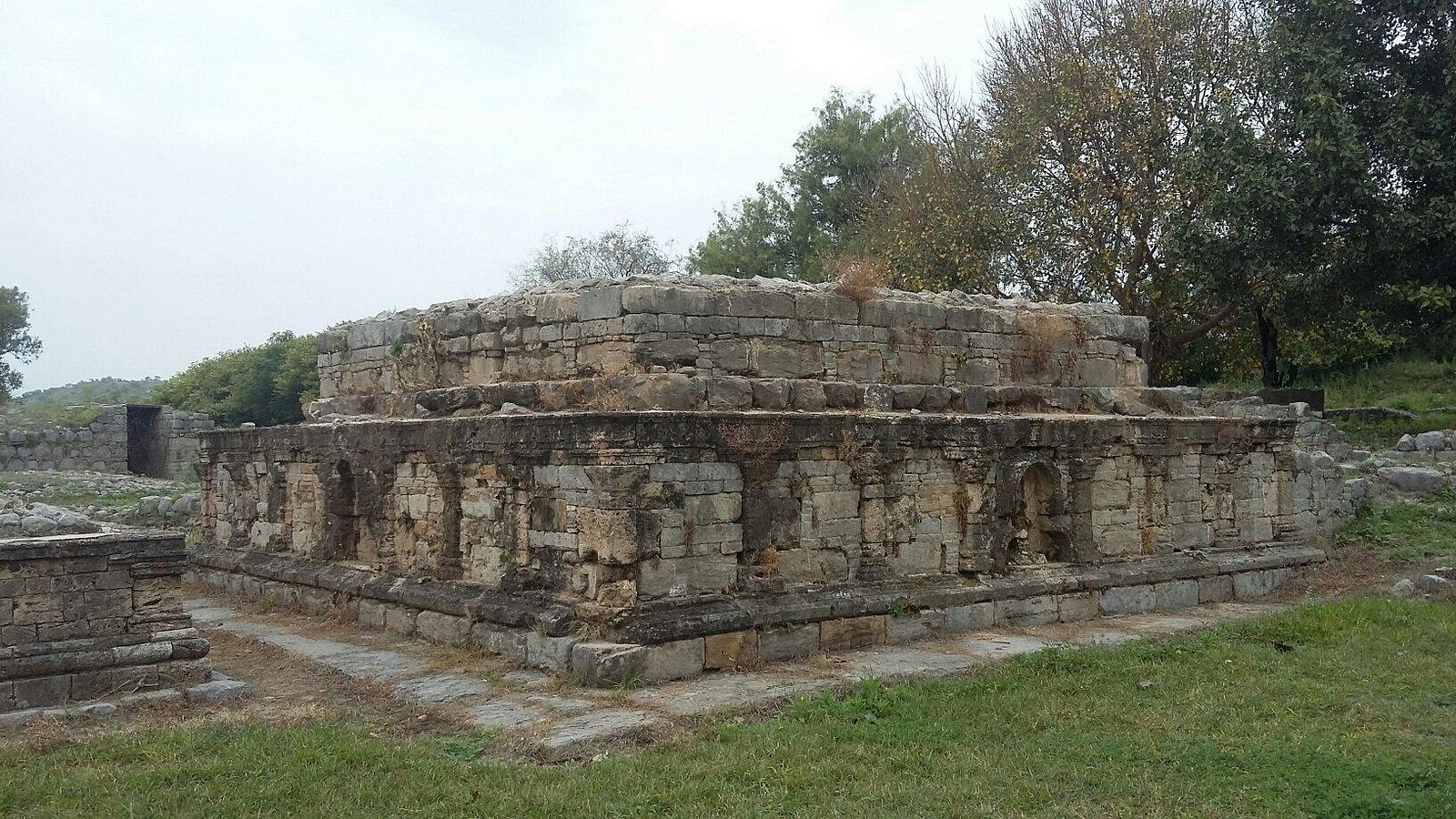
Walking the main excavated street of Sirkap, you can identify the foundations of temples, shops, and residential quarters. Look out for the Apsidal Temple, a remarkable structure combining Greek architectural columns with a Buddhist stupa — a perfect architectural symbol of the cultural synthesis that defines Gandhara. The Shrine of the Double-Headed Eagle is another highlight: a decorative frieze bearing a motif found in Greek, Persian, and Indian traditions simultaneously, a stone testament to Taxila’s extraordinary cosmopolitan character. The Royal Palace area is also visible within Sirkap, where successive dynasties held court over the centuries.
Sirsukh (2nd Century CE Onwards)
The third and final city, Sirsukh, was built during the reign of the Kushan Empire — the great Central Asian dynasty that became the most generous patrons of Gandharan Buddhist art. Less thoroughly excavated than Sirkap, Sirsukh’s most striking feature is its imposing defensive perimeter: massive walls of diaper masonry that march across the landscape and give a visceral sense of the scale of the Kushan city. Emperor Kanishka I, the greatest of the Kushan rulers and a fervent Buddhist patron, likely held court here during the 2nd century CE.
Key Buddhist Sites at Taxila
Beyond the three cities, the Taxila valley is scattered with Buddhist monuments of extraordinary importance. Allow time for at least three of the following sites — each has its own distinct atmosphere and historical significance.
Dharmarajika Stupa and Monastery
Dharmarajika is arguably the most spiritually significant site in the entire Taxila complex. The great stupa here — one of the oldest in South Asia — is traditionally credited to the Emperor Ashoka (3rd century BCE), who according to Buddhist tradition enshrined relics of the Buddha himself within it. Even stripped of legend, the archaeology confirms extraordinary antiquity: the original core stupa is surrounded by centuries of later additions, as generations of devotees added votive stupas, monastic cells, and shrines in an ever-expanding cluster of religious architecture.
Walking among the ruins of Dharmarajika at dawn or dusk, when the light turns the ancient brickwork to gold, is one of the quietly profound experiences available to travellers in Pakistan. There is no queue, no barrier, no souvenir stall. Just you, the ruins, and two and a half thousand years of Buddhist devotion.
Jaulian Monastery
Perched on a low hilltop above the Haro River valley, Jaulian is the best-preserved monastery at Taxila and, for many visitors, the undisputed highlight of the entire site. Dating from the 2nd century CE Kushan period, the monastery is arranged around two courtyards: a main stupa court surrounded by votive stupas encrusted with stucco decorative panels, and a monastery court lined with monks’ cells.
What makes Jaulian extraordinary is the quality and quantity of surviving Gandharan sculpture. Buddha and Bodhisattva figures in stucco — serene, Hellenistic in their modelling, yet unmistakably Buddhist in their iconography — remain in situ on the bases of votive stupas, exactly where Kushan-era craftsmen placed them nearly two thousand years ago. Standing among them, you are looking at one of the greatest concentrations of early Buddhist art surviving anywhere on Earth. The hilltop setting also provides sweeping views across the valley.
Mohra Moradu
A short drive from Jaulian, Mohra Moradu is a monastery and stupa complex set in a tranquil garden environment that feels almost like a private discovery. The stucco decoration here is particularly well-preserved, and the site is invariably quieter than Jaulian — ideal for those who want to linger and absorb the atmosphere without distraction.
Taxila Museum — An Essential First Stop
Before venturing out to the field sites, spend a morning at Taxila Museum. It ranks among the finest museums of Gandharan art in the world and provides the visual and historical context that will transform your experience of the ruins.
The collection spans the full chronological range of Taxila’s occupation, from Indus Valley artefacts through Achaemenid-era objects, Indo-Greek coins, Mauryan stonework, and the crowning glory: an exceptional assemblage of Kushan-period Gandharan sculptures in grey schist, white stucco, and terracotta. The Buddha figures here — with their wavy hair, toga-like robes, and expression of transcendent calm — are among the most beautiful examples of the Gandharan style anywhere. Allow a generous 1.5 to 2 hours. Entrance is approximately PKR 200–300, and guides are available for hire at the entrance.
Getting to Taxila from Islamabad
One of Taxila’s great practical virtues is its proximity to Islamabad. The drive of approximately 35 kilometres takes between 45 minutes and an hour by road, making Taxila a straightforward and highly rewarding day trip from the capital.
The most comfortable option for independent travellers is to hire a private car and driver from Islamabad for the day — your hotel can arrange this, or a reputable local tour operator can organise a vehicle with an English-speaking guide. Budget approximately PKR 2,000–3,000 for a day car hire. Alternatively, Passage to Pakistan offers tailored day tours from Islamabad combining Taxila with expert Gandharan specialist guides. Public transport (local buses from Rawalpindi) exists but is not practical for touring the widely dispersed field sites. A private vehicle is essential.
A Day at Taxila: Suggested Schedule
- 8:30am — Arrive at Taxila Museum; allow 1.5 hours with the collection
- 10:00am — Drive to Dharmarajika Stupa (approximately 20 minutes from the museum)
- 11:00am — Drive to Jaulian Monastery (approximately 15 minutes from Dharmarajika); allow 1 hour
- 12:30pm — Lunch in Taxila bazaar, or enjoy a packed lunch brought from Islamabad
- 1:30pm — Drive to Sirkap city ruins; explore for 1.5 hours
- 3:00pm — Optional: Mohra Moradu monastery (20 minutes from Sirkap)
- 4:30pm — Begin return drive to Islamabad
Opening hours for all sites and the museum are 8:30am to 5:00pm, seven days a week. Individual site entry fees range from PKR 100 to PKR 300. Photography is permitted throughout.
Combining Taxila with Other Destinations
Islamabad is the natural base for Taxila. The capital’s Lok Virsa Museum, dedicated to Pakistan’s folk and traditional cultures, makes an excellent complement to a Taxila day.
Peshawar, two to three hours west of Islamabad along the Grand Trunk Road, offers two major Gandharan rewards: the Peshawar Museum, whose sculpture collection rivals Taxila’s own, and Takht-i-Bahi, the best-preserved Buddhist monastery in Pakistan, perched dramatically on a hill above the Mardan plain. Takht-i-Bahi was designated a UNESCO World Heritage Site in 1980 alongside Taxila, and the two sites complement each other beautifully.
Lahore, three to four hours south-east by road, houses the Lahore Museum’s legendary Fasting Siddhartha — a skeletal, intensely realistic sculpture of the meditating future Buddha that many scholars consider the greatest single work of Buddhist art in existence. Lahore also offers the Mughal splendours of Lahore Fort and Shalimar Gardens, both UNESCO-listed.
Swat Valley, two to three hours north of Peshawar, was another major centre of Gandharan civilisation and contains dozens of Buddhist sites set against spectacular mountain scenery.
Historical Context: Why Taxila Truly Matters
The name Taxila — ancient Takshashila — appears in Hindu, Buddhist, Greek, and Chinese ancient texts. It was the site of Takshashila University, one of the world’s earliest centres of higher learning, which attracted students and scholars from across the ancient world centuries before the famous libraries of Alexandria were even founded.
Chanakya — also known as Kautilya — the brilliant political philosopher whose Arthashastra is often compared to Machiavelli’s The Prince, studied and later taught here. His pupil Chandragupta Maurya used Taxila as a base from which to build an empire spanning the Indian subcontinent. Alexander the Great’s alliance with Taxila’s king Ambhi was what opened the door to his invasion of India — without Taxila’s co-operation, the Macedonian campaign east of the Indus might never have happened.
The Chinese Buddhist pilgrim Fa Hian visited Taxila around 400 CE and recorded that the city was still a thriving centre of Buddhist learning. Two centuries later, the great scholar-monk Xuanzang visited around 630 CE and left a detailed written account that remains an invaluable historical source today. Few sites on Earth can claim a continuous historical record spanning from the 5th century BCE to the 7th century CE — over a thousand years of unbroken significance. Taxila is one of them.
Practical Information at a Glance
- Opening hours: 8:30am–5:00pm, all days
- Entry fees: Museum PKR 200–300; individual sites PKR 100–300 each
- Guides: Available at museum entrance — strongly recommended
- Facilities: Basic café near the museum; bring bottled water for field sites
- Footwear: Comfortable, closed walking shoes essential — surfaces are uneven
- Photography: Permitted at all sites
- Time needed: A full day for museum plus three field sites
When to Visit Taxila
The best time to visit Taxila is between October and March, when temperatures in the Rawalpindi/Islamabad region are pleasant for outdoor exploration — typically ranging from 5°C to 20°C. Spring (March–April) is particularly beautiful, with wildflowers appearing around the ruins and the Margalla Hills looking lush and green. The summer months of June through August are best avoided: temperatures regularly reach 35–45°C in the region, and exploring archaeological sites in that heat is genuinely uncomfortable.
Visit Taxila with Passage to Pakistan
Taxila is a site that rewards depth of knowledge. Walking among ruins without understanding what you are looking at is a very different experience from exploring them with an expert who can bring the Gandharan world vividly to life — who can point out the Greek column capital embedded in a Buddhist shrine, explain the iconographic significance of a Buddha’s hand gesture, and trace the journey of an artistic idea from ancient Athens to a monastery courtyard in the Haro River valley.
Passage to Pakistan offers expert-guided day tours from Islamabad focused on Taxila and the Gandharan world, as well as multi-day itineraries combining Taxila with Peshawar, Takht-i-Bahi, and the ancient sites of Swat — a comprehensive Gandharan journey that few tour operators worldwide are equipped to deliver.
Whether you are visiting Pakistan primarily for its mountains or its history, Taxila deserves a place on your itinerary. It is, quite simply, one of the great archaeological sites of Asia — and it is waiting for you.
Contact Passage to Pakistan to plan your Taxila day trip or Gandharan circuit tour.