What Is Kalash Valley Pakistan — and Why Should UK Travellers Go?
Kalash Valley Pakistan sits in the Hindu Kush mountains of Chitral district, Khyber Pakhtunkhwa, at altitudes between 1,900 and 2,200 metres above sea level. It is home to the Kalash people — one of the smallest and most culturally distinct indigenous communities in South Asia, numbering approximately 3,500 to 4,000 individuals. The Kalash follow a pre-Islamic polytheistic religion, making them unique in a country that is overwhelmingly Muslim. Their wooden temples, carved shrines, distinctive dress and calendar of festivals draw researchers, documentary filmmakers and culturally curious travellers from across the world.
In 2025, Pakistan recorded an 820 per cent increase in international visitor arrivals compared to the previous year, according to Pakistan’s own tourism authorities. Chitral and the Kalash valleys were among the destinations cited in that growth. For UK visitors who want something genuinely different from the popular Hunza-Skardu trail — a place where anthropology, mountain scenery and living cultural heritage converge — Kalash Valley Pakistan delivers an experience found nowhere else on the planet. Specialist UK tour operators including Wild Frontiers have run Chitral and Kalash itineraries for years, demonstrating consistent British market interest in this destination.
This guide covers the three valleys in detail, the Kalash festivals that attract most visitors, the logistics of getting from Islamabad to Chitral, accommodation options, and everything a UK traveller needs to plan and budget for the trip.
Key facts at a glance:
- Location: Chitral district, Khyber Pakhtunkhwa — approximately 380 km north of Islamabad
- Altitude: 1,900–2,200 m in the main valleys
- Three valleys: Bumburet (most visited), Rumbur (quieter), Birir (most remote)
- Best months: May (Chilam Joshi festival), August (Uchal festival), October (autumn colour), December (Choimus festival)
- Budget: approximately £35–£100 per day in the valley depending on travel style
- Travel time from London: approximately 16–20 hours including connections to Islamabad
The Three Kalash Valleys: Bumburet, Rumbur and Birir
The three Kalash valleys run roughly parallel to one another, branching westward from Chitral city. Each has its own character, and most visitors with only one or two days in the area base themselves in Bumburet. Travellers with more time divide their stay across all three.
Bumburet Valley
Bumburet is the largest and most accessible of the three Kalash valleys. It lies approximately 35 km from Chitral city along a paved-then-dirt road and can be reached by jeep in roughly 1.5 to 2 hours. The valley floor sits at around 2,000 m and rises steeply on both sides into pine-forested ridges above terraced fields of maize and wheat.
Bumburet holds the highest concentration of Kalash population and the greatest number of guesthouses, making it the logical base. The main settlement, Anish, contains several wooden Kalash temples known as JestakHan as well as a small museum dedicated to Kalash culture that was established with support from the Greek government in the 1990s. This museum is worth an hour of anyone’s time — it contains artefacts, woven textiles and explanatory panels covering Kalash religion, festivals and genetic history. Bumburet also hosts the largest Chilam Joshi gatherings in May, drawing Kalash communities from all three valleys.
Rumbur Valley
Rumbur lies north of Bumburet and is reached by a separate jeep track from the main Chitral road. It is quieter, with a smaller Kalash population concentrated in the villages of Grom and Guru. Rumbur feels less developed than Bumburet — the guesthouses are more basic, the festival gatherings smaller — but many travellers find it more rewarding for exactly those reasons. The valley is narrower, the terraced fields more compact, and the sense of distance from the outside world more pronounced.
Bumburet and Rumbur are not directly connected by road inside the valleys. You must return to the main Chitral highway and re-enter on the Rumbur track, adding roughly 40 minutes of driving. A day trip between the two valleys is a standard addition to any Bumburet-based itinerary.
Birir Valley
Birir is the southernmost and most traditional of the three valleys. The Kalash community here is considered the most conservative in its adherence to older customs, and outside visitors are relatively rare compared to Bumburet. The valley is approximately 35 km south of Chitral city along a rougher road than the Bumburet route.
Birir holds particular appeal for researchers, photographers and travellers who specifically seek out places where tourism infrastructure has not yet softened the edges of daily life. Accommodation is extremely basic. If you plan to visit Birir, treat it as a day excursion from Chitral city or from Bumburet, unless you are comfortable with very simple conditions and bring your own supplies.
Kalash Culture, Festivals and Way of Life
The Kalash people are one of the most studied and debated indigenous communities in academic literature. A peer-reviewed DNA study published in Scientific Reports in 2025 confirmed that the Kalash represent a genetically distinct population with partial ancestry connecting them to ancient West Eurasian groups. The popular claim that they descend from soldiers of Alexander the Great is a romantic theory without substantive archaeological support — but their genetic, linguistic and cultural distinctiveness is not disputed by any serious researcher.
The Kalash language, called Kalasha, belongs to the Indo-Aryan branch of the Indo-European family and is spoken by approximately 5,000 people. It is not mutually intelligible with Khowar (the main language of Chitral), Dari, Pashto or Urdu.
The Three Kalash Festivals
The Kalash calendar is structured around three principal festivals, each marking a seasonal or agricultural transition. Visiting during one of these festivals is the single most powerful reason to time your trip carefully:
- Chilam Joshi (May, approximately 13–16 May): The spring festival marks the arrival of warmer weather and the return of flocks to higher pastures. Women and girls dance in procession wearing their full ceremonial dress, flowers are placed on the horns of animals, and the valley fills with music played on traditional instruments. This is the most photographed and widely attended festival, drawing both Pakistani visitors and international travellers in significant numbers.
- Uchal (late July to mid-August): A summer harvest festival focused on dairy products, particularly fresh cheese and clarified butter. Women make offerings at shrines, and the celebration centres on the abundance of the season. In 2026, the Uchal festival ran from 16 to 30 August across the three valleys.
- Choimus (December, approximately 7–22 December): The winter solstice festival is the longest and most sacred in the Kalash calendar. Purification ceremonies, feasting on sacrificed animals, music, torchlit processions and dancing mark the period around the solstice. Choimus is considered by Kalash scholars to hold the deepest religious significance. It also falls during a cold and logistically more demanding time of year for outside visitors.
Visiting during a festival is strongly recommended for any traveller who wants to understand Kalash culture rather than simply observe it as scenery. The Kalash welcome respectful visitors at their festivals. Photography of women and inside shrines requires explicit permission — do not assume it is granted because no one has objected yet. Hiring a local Kalash guide is the most effective way to navigate festival etiquette and avoid crossing cultural or sacred boundaries without realising it.
Dress and Visual Culture
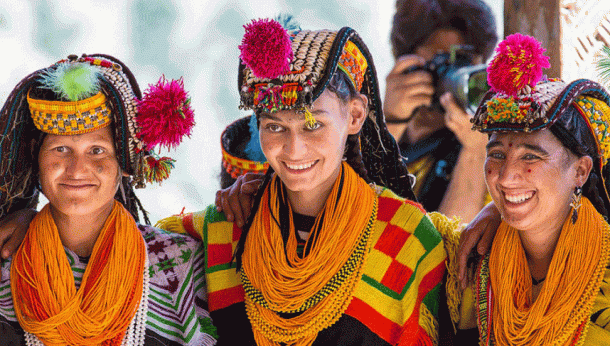
Kalash women wear black wool robes with brightly coloured embroidered bodices and elaborate headdresses covered in shells, beads, buttons and coins. The headdress is built up over years and represents a woman’s family wealth and social standing. Men typically dress in standard Pakistani or Afghan clothing, though traditional male dress still appears during festivals.
Kalash woodcarving is distinctive and worth seeking out — the carved horse effigies placed on the roofs of shrines and at burial sites are among the most recognisable visual markers of the culture. These objects are sacred. Do not touch or move them.
How to Get to Kalash Valley from Islamabad
Reaching Kalash Valley Pakistan from the UK involves two journeys: London to Islamabad, and Islamabad to Chitral.
London to Islamabad
Several airlines operate between London Heathrow (LHR) and Islamabad International Airport (ISB). Pakistan International Airlines (PIA) offers direct services of approximately 7 hours 30 minutes; return fares typically run from £480 to £700 depending on season. Qatar Airways, Emirates, Turkish Airlines and Flydubai operate one-stop routes via Doha, Dubai or Istanbul, often at competitive prices in the £400 to £650 return range. Book well in advance for the May and August festival periods — these see high demand from both Pakistani diaspora and international visitors.
Islamabad to Chitral: Two Options
By air: PIA operates a domestic service between Islamabad and Chitral Airport (CJL). The flight takes approximately 55 minutes and costs around PKR 8,000 to 14,000 one way (approximately £22 to £40). Seats are limited, the service is weather-dependent, and Chitral Airport’s short runway at 1,498 m elevation means cancellations occur without much notice, particularly in winter or during monsoon. Book early, carry cash, and do not schedule time-critical onward connections on the same day as a Chitral domestic flight.
By road: The overland route from Islamabad passes through the Swat Valley, up through Dir district, and through the Lowari Tunnel (3.7 km long, completed 2017) into Chitral. Total distance is approximately 380 to 420 km and journey time is 10 to 14 hours by private vehicle. A private car or jeep hire from Islamabad costs around PKR 25,000 to 40,000 (approximately £70 to £110). Many travellers prefer the road: the scenery through Swat and Dir is impressive, the journey is more reliable than the flight, and you arrive with a sense of the landscape that a one-hour flight cannot give you.
Chitral city to Bumburet: From Chitral city, the onward jeep ride to Bumburet Valley is approximately 35 km on a mixed tarmac-and-dirt road, taking 1.5 to 2 hours. Shared jeeps depart when full from Chitral bazaar; a private jeep hire costs approximately PKR 3,000 to 5,000 (roughly £8 to £14).
Permits and Registration
As of 2026, foreign visitors to the Kalash valleys do not need a specific trekking permit. You are required to register with the local administration in Chitral as a foreign national — a process your guesthouse or tour operator will typically handle on your behalf. The valleys charge a small conservation fee of approximately PKR 500 to 1,000 per person (roughly £1.50 to £3) at the valley entrance. Always check the current position on the FCDO travel advice page at gov.uk/foreign-travel-advice/pakistan before departure, as administrative requirements for foreign nationals in Khyber Pakhtunkhwa can change on short notice.
Where to Stay and What to Eat
Accommodation in the Valleys
Bumburet has the widest range of accommodation in the Kalash valleys. Options run from very basic guesthouses with shared outdoor facilities at PKR 1,500 to 2,500 per night (approximately £4 to £7) to mid-range places with attached rooms and simple hot-water showers at PKR 4,000 to 7,000 (approximately £11 to £20). There is no high-end hotel in Bumburet itself.
Travellers who want more comfortable accommodation base themselves in Chitral city, where the PTDC Motel and several private mid-range hotels offer rooms at PKR 7,000 to 15,000 (approximately £20 to £42) per night. From Chitral city, the Kalash valleys are accessible as day trips — though staying inside Bumburet at least one night gives you access to the valley after the day-trippers from Chitral have left, which is when the atmosphere is most genuine.
Rumbur has a handful of very basic guesthouses. Birir has minimal facilities and should be treated as a day excursion for most visitors.
Food and Drink
Food in the guesthouses is simple but filling. Expect rice, lentils, chapati and vegetable curries; meat dishes are available but not always consistently sourced. The Kalash produce their own walnut oil, dried mulberries and a traditional drink made from grape and mulberry juice that is fermented into a mild wine — one of the very few places in Pakistan where alcohol is produced and consumed as part of traditional cultural practice. This wine is available in some Kalash households and guesthouses.
Chitral city itself offers a broader range of restaurants serving standard Pakistani food — karahi, biryani, kebabs — at very reasonable prices. Budget approximately £4 to £8 per day for food in valley guesthouses and £8 to £15 per day dining in Chitral city.
Practical Travel Tips for UK Visitors
Pakistan E-Visa for UK Citizens
UK passport holders can apply for a Pakistan e-visa through the official Pakistan online visa portal. Tourist visas are issued within 5 to 10 working days and cost approximately $50 USD (around £40) for a single-entry 30-day visa. A 90-day multiple-entry tourist visa is also available at a slightly higher fee. Apply at least two weeks before your intended travel date to allow processing time. For current information on processing times and documentation requirements, check the British Embassy Islamabad website or the Pakistani government’s official e-visa portal directly.
Travel Insurance
Standard UK travel insurance policies frequently exclude Pakistan or Khyber Pakhtunkhwa province. Use a specialist insurer — True Traveller, Campbell Irvine and Battleface are three UK-based options known to cover Pakistan including KPK province. Ensure your policy includes emergency medical evacuation, because the nearest hospital facilities with adequate surgical capacity are in Peshawar or Islamabad, several hours from Chitral even by air. Medical evacuation from Chitral without insurance could cost between £15,000 and £30,000.
FCDO Travel Advice
The UK Foreign, Commonwealth and Development Office (FCDO) classifies different areas of Pakistan at different advisory levels. Chitral and the Kalash valleys are not subject to an outright “do not travel” advisory — the position is generally one of “exercise a high degree of caution” for Khyber Pakhtunkhwa. Many hundreds of UK and European travellers visit Chitral and the Kalash valleys each year without incident. Carry the British Embassy Islamabad emergency number (+92 51 201 2000) and keep a digital copy of your passport and visa stored separately from the originals.
Currency and Budget
Pakistan uses the Pakistani Rupee (PKR). At the time of writing, the exchange rate is approximately £1 = PKR 350 to 360. ATMs are available in Islamabad and Peshawar, limited in Chitral city, and non-existent in the Kalash valleys. Carry sufficient Pakistani cash from Islamabad — exchange at a reputable money changer rather than at the airport, where rates are significantly worse.
A realistic per-day budget for a UK visitor in the Kalash valleys:
- Budget (basic guesthouse, shared facilities, cook-your-own or simple meals): £35–£50 per day
- Mid-range (attached room, private transport, local guide): £70–£100 per day
- Organised tour (all-inclusive, guide, private vehicle, better accommodation in Chitral): £120–£180 per day
A full 10-day trip covering Islamabad, the Swat Valley, Chitral city and the Kalash valleys — booked through a specialist Pakistan operator — typically costs between £1,800 and £2,800 per person including return flights from London Heathrow.
Physical Preparation
The Kalash valleys are not a technical trekking destination. No glacier crossings, no altitude camps, and no mountaineering experience are required to visit the main settlements. The jeep roads are rough and walking between villages involves uneven terrain with some elevation gain, but standard walking fitness — comparable to a day on the Brecon Beacons or in the Peak District — is entirely adequate for a valley visit. If you plan to walk between Bumburet and Rumbur via the ridgeline path (a 4 to 6 hour walk used by some independent travellers), a moderate level of hill-walking experience is useful but not strictly necessary in good weather.
If you are booking organised Pakistan tour packages that include the Kalash valleys as part of a longer northern Pakistan itinerary, your operator will advise on the specific fitness requirements for any optional walks.
Frequently Asked Questions
Is Kalash Valley Pakistan safe for UK tourists?
Chitral and the Kalash valleys have a generally positive safety record for foreign visitors. The FCDO does not prohibit travel to Chitral. Khyber Pakhtunkhwa province as a whole carries an elevated advisory, and you should monitor the FCDO Pakistan page throughout your planning and in the weeks before departure. Registering with local authorities and using a reputable local guide or tour operator are both standard practice. The British Embassy Islamabad (+92 51 201 2000) should be in your phone contacts for the duration of your trip.
Do I need a local guide to visit the Kalash valleys?
A guide is not legally required but is strongly recommended. A Kalash-speaking local guide helps you navigate festival etiquette, introduces you to community members, explains the significance of what you are seeing, and ensures you do not inadvertently enter sacred spaces or photograph subjects who would object. Guide fees in Bumburet typically run to PKR 3,000 to 5,000 per day (approximately £8 to £14). Your guesthouse can arrange a reputable local guide in most cases.
Can I visit the Kalash valleys during Choimus in December?
Yes, though December visits require more preparation. Temperatures in Bumburet drop to around 0 to 5°C at night, and the road from Chitral may be affected by snow or ice in heavy winters. Some guesthouses close in winter. Choimus (approximately 7–22 December) is the most sacred Kalash festival, and visitor numbers are lower than in May or August — meaning a quieter, more intimate experience but with fewer logistical conveniences. Dress in proper cold-weather layers and confirm road conditions before departure from Chitral.
What should I wear when visiting the Kalash valleys?
Modest dress is appropriate throughout: long trousers or skirts, covered shoulders. Although the Kalash are not Muslim, respect for community norms is the right approach. Women should avoid sleeveless tops or shorts outside of guesthouse settings. Bring warm layers in all seasons, as evenings at 2,000 m can be cold even in midsummer. Good walking shoes or light trail footwear is more useful than sandals, given the uneven ground between villages.
How many days should I plan for the Kalash valleys?
Allow a minimum of two full days in Bumburet to get a meaningful sense of daily life, explore the main villages and JestakHan temples, and visit the cultural museum. Three to four days allows you to add Rumbur, take an optional ridge walk, and time your presence around a market day or smaller community gathering. Five or more days creates space to visit Birir, contribute more to the local guesthouse economy, and engage more deeply with community members — which is when the most memorable moments tend to emerge.
Start Planning Your Kalash Valley Pakistan Journey
The Kalash valleys offer one of the most genuinely uncommon cultural encounters available to a UK traveller anywhere in the world — and they remain, for now, uncrowded and accessible to those who plan well. Passage to Pakistan has been taking international visitors into these mountains for years and understands the logistics from London Heathrow to Bumburet inside out. Browse our Pakistan tour packages to find Chitral and Kalash itineraries designed for UK travellers, or contact us to build a custom route that fits your travel dates and festival priorities. Whether you want a two-week cultural immersion or a shorter combined trek-and-culture itinerary, our team can put it together. Visit passagetopakistan.pk to get started.