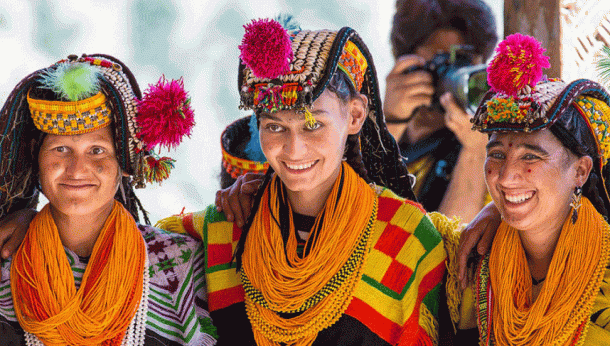
Picture this: you are standing at the edge of Attabad Lake in Hunza at seven in the morning, the water an almost impossible shade of turquoise, a chai wallah pressing a steaming cup into your hands before you have even asked for one. A local family spots your camera and waves you over. Twenty minutes later you are sharing flatbread and laughter with strangers who have, somehow, become friends.
This is what thousands of foreign travellers discovered about Pakistan in 2024 — a country that surprised them completely. And yet, before they booked their flights, almost every one of them typed the same question into a search engine: is Pakistan safe for tourists?
You are probably here for the same reason. So let us give you the honest, ground-level answer.
What the Numbers Actually Tell You
Pakistan welcomed 1.3 million international tourists in 2024 — a 30 percent increase from the year before. That figure did not happen by accident. It reflects a genuine shift in how the world is beginning to see Pakistan: more infrastructure, better organised tours, and a growing wave of travellers returning home and telling friends that the reality bore no resemblance to the headlines.
The United Kingdom, Germany, and Japan have each softened their official travel advisories for major cities and popular tourist regions. That matters. These governments have consular staff on the ground, intelligence briefings, and a legal obligation to tell their citizens the truth. When they update their guidance in a positive direction, it signals a measurable change — not a marketing campaign.
Does that mean Pakistan is without risk? No. And anyone who tells you otherwise is not being honest with you. But the honest picture is this: violent crime against foreign visitors is extremely rare. The challenges most travellers actually face are the ordinary kind — a delayed bus, a patchy mobile signal in a remote valley, or the difficulty of finding vegetarian food in certain areas. Serious incidents involving tourists happen far less frequently than in many destinations that Western travellers visit without a second thought.
Where Is Safe — and Where to Apply More Caution
Pakistan is a large country, and safety is not uniform across it. Knowing the difference between regions is what makes a well-planned trip entirely possible.
The areas that receive the vast majority of foreign tourists — and where incidents involving visitors are genuinely rare — include Islamabad, Lahore, Multan, the Swat Valley, and Gilgit-Baltistan. Islamabad, as the capital, has a strong security presence and a well-established diplomatic community. Hunza Valley and Skardu in Gilgit-Baltistan have been welcoming international trekkers and mountaineers for decades; the communities there have a long-standing tradition of hospitality toward foreign guests.
The regions that require real caution are the border zones — particularly areas close to Afghanistan and Iran, interior Balochistan, and some former tribal areas. These do not feature on any standard tourist itinerary. Any reputable tour operator will route you well away from them, and ours is no exception.
One practical detail most first-time visitors do not know about: Pakistan has a dedicated Tourist Police force operating in major cities, and a 24/7 helpline reachable at 1422. If something goes wrong, you are not navigating the system alone.
The New e-Visa Process Every Foreign Visitor Needs to Know
Here is a change that matters for anyone planning a trip this year. As of January 2026, Pakistan suspended its Visa on Arrival programme and the Visa Prior to Arrival option that once let travellers from 126 nationalities obtain approval in a day or two. All visitors from the UK, the United States, EU member states, Australia, and Canada now need to apply for an e-visa in advance through the official NADRA portal at visa.nadra.gov.pk.
Processing time is now 7 to 20 business days, and the fee runs between USD 35 and 60 depending on your nationality. You will need to upload a scan of your passport bio page, a recent photograph, a hotel booking or invitation letter, and a travel itinerary. Some nationalities may also be asked to provide proof of funds.
The practical advice: apply at least four to six weeks before your planned departure. Do not leave this to the last minute. The process is bureaucratic rather than difficult, and once your e-visa arrives, you present it on arrival and proceed. The team at Passage to Pakistan routinely helps guests with the documentation process as part of their tour planning — if the paperwork feels like a lot, that is something we work through together.
The Real Questions Most First-Time Visitors Are Asking
Beyond formal advisories and visa logistics, there are quieter concerns that often go unasked. Women travelling in small groups or solo are a growing part of Pakistan's international visitor base. The country has cultural conservatism in some areas, and as a foreign face you will attract curiosity — but curiosity is almost universally what it is. Dressing modestly, keeping a dupatta scarf to hand in rural areas, and travelling with a local guide smooths most interactions considerably. Many solo female travellers have completed long journeys through Pakistan and written about their experiences at length; the collective testimony is a useful data point alongside formal government advisories.
Language is far less of a barrier than most people expect. English is widely spoken in cities, along main tourist routes, and by every guide and hotelier you are likely to work with. In remote mountain villages, a local guide bridges the gap — and the warmth of a welcome does not require a shared language to come through clearly.
Food safety follows the same common sense as travel anywhere in South Asia: stick to freshly cooked food, avoid tap water, and carry rehydration sachets. Pakistani food is extraordinary — the slow-cooked lamb karahi in Lahore, the smoky river fish along the Indus, the thick cardamom-laced milk tea that arrives everywhere uninvited and is always welcome. Eating well is genuinely one of the great pleasures of travelling here.
Political turbulence does occur, and major demonstrations occasionally disrupt movement in cities. Staying in contact with your guide, following local news during your trip, and keeping some flexibility in your itinerary means this very rarely becomes a practical problem for visitors.
Why Who You Travel With Changes Everything
The single biggest factor in having a safe, rewarding first trip to Pakistan is who you travel with. Some independent travellers navigate the country brilliantly, but for most foreign visitors — particularly on a first visit — working with an experienced local operator transforms what is possible.
A good Destination Management Company knows which roads are open, which mountain passes have seasonal access restrictions, which guides are trusted in their communities, and how to adapt plans quickly when circumstances change. That knowledge does not live in any app. It comes from years of running trips on the ground, across every season and every region on the itinerary.
If you are genuinely curious about Pakistan — its mountains, its ancient sites, its food, its people — but not yet certain whether the timing is right, that is exactly the conversation we want to have. Our team builds Pakistan tour packages for foreign visitors of all experience levels, including first-timers who arrived with nerves and left already searching for dates to return.
Reach out to Passage to Pakistan, tell us your travel window and your honest concerns, and we will give you a realistic picture of what your trip can look like. No overselling. No glossing over the questions that matter. Just the information you need to decide whether this is the year you finally go.