Picture this: you are standing on a viewing platform in Karimabad at dusk. The air is thin and cold against your face, and the Rakaposhi massif turns a deep shade of coral as the last of the sun pulls back behind the ridgeline. Below you, apricot orchards spread across terraced slopes that farmers have been coaxing from the mountainside for centuries. Someone nearby is brewing tea on a small gas burner and the smell of cardamom drifts past. At that moment, every hour of travel it took to reach this place makes complete sense.
This Hunza Valley travel guide is written for people who are seriously planning a trip, not just daydreaming about one. You will find practical information here: how to get to Hunza, the best time of year to visit, what to see and in what order, where to sleep and eat on different budgets, and honest answers to questions that travel blogs usually skip over.
Where Is Hunza Valley and Why Does It Matter
Hunza Valley sits in Gilgit-Baltistan, the northernmost territory of Pakistan, at elevations ranging from around 2,400 metres in the lower valley to over 4,600 metres at Khunjerab Pass on the Chinese border. The valley is roughly 100 kilometres long and is carved by the Hunza River, which eventually joins the Gilgit River further south.
People often describe it as one of the most dramatic landscapes on earth, and that is not an overstatement. The valley sits at the convergence point of three of the world greatest mountain ranges: the Karakoram, the Himalayas, and the Hindu Kush. Nowhere else on the planet do those three ranges meet. Within a day drive of Karimabad, you have views of Rakaposhi (7,788m), Ultar Sar (7,388m), Diran (7,257m), Golden Peak (7,027m), and Lady Finger (6,000m) all accessible by eye from the valley floor.
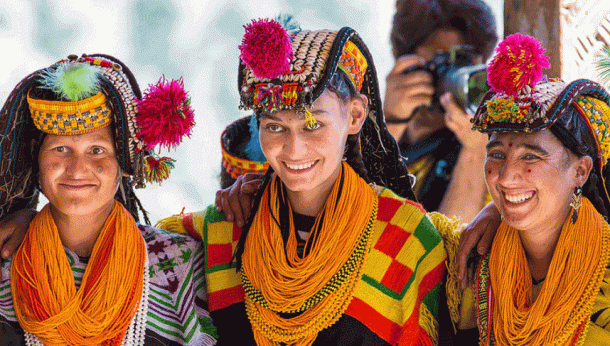
But Hunza is not only about mountains. The Hunza people have a reputation for extraordinary hospitality, and the valley has a long history as a stopover on the ancient Silk Road. The old kingdom of Hunza was semi-independent until 1974, and that history is still visible in the forts, watchtowers, and oral traditions that local guides are proud to share.
The Best Time to Visit Hunza Valley
There is no single right answer because different seasons offer completely different experiences.
Spring (mid-March to late April) is when the cherry blossom and apricot bloom transforms the valley into something that does not look entirely real. The orchards go from bare winter branches to clouds of pink and white in the space of a week or two. This is arguably the most photographed event in all of Pakistan, and it draws visitors from across the country and internationally. Temperatures are mild during the day (10 to 18 degrees Celsius) but cold at night. Spring in Hunza can be unpredictable, with snow at the higher elevations and occasional rain in the valley. Book accommodation well in advance if you plan to visit during blossom season.
Summer (May to August) is when Hunza is most accessible and the high-altitude treks are fully open. The Khunjerab Pass opens for the season, usually in May, which means you can travel the Karakoram Highway all the way to the Chinese border. Temperatures in the valley are comfortable (20 to 30 degrees Celsius in the day), though the higher passes remain cold. This is the peak season and the valley is at its greenest. If trekking is your priority, summer is your window.
Autumn (September to November) is when the poplar and apricot trees turn gold and orange and the sky above Karimabad takes on a clarity that photographers chase all year. The harvest is underway: apricots drying on rooftops, corn being husked by hand, walnuts cracked open on stone steps. The days are warm, the nights are cold, and the crowds are thinner than in spring or summer. Many experienced travellers consider autumn the finest season of all.
Winter (December to February) brings temperatures well below freezing and the higher roads are often snowed in. The Khunjerab Pass closes entirely. A small number of visitors come in winter specifically for the silence and the snow-covered peaks, but this is not a season for first-time visitors or anyone planning to trek.
How to Get to Hunza Valley
Getting to Hunza takes time and planning. There is no direct train service and no commercial airport in the valley itself. Your options are road travel, a flight to Gilgit followed by a drive, or a combination of both.
The Karakoram Highway (KKH) from Islamabad is the classic route and one of the most scenic road journeys in the world. The drive from Islamabad to Karimabad covers roughly 600 kilometres and takes 14 to 16 hours by private vehicle or NATCO bus, depending on stops and road conditions. The highway passes through the Indus Valley, crosses the Nanga Parbat region at Chilas, continues through Gilgit, and then climbs into Hunza. It is a long journey but the scenery in the final four hours, from Gilgit onwards, is exceptional. A private car hired through a local tour operator is more comfortable and allows you to stop where you want. NATCO buses are significantly cheaper and depart from Rawalpindi in the late evening.
Flying to Gilgit cuts the ground journey by roughly half. PIA operates flights from Islamabad to Gilgit Airport, but these flights are highly weather-dependent and cancellations are common. The mountain weather in the Gilgit corridor is notoriously unpredictable, and it is not unusual for flights to be cancelled two or three times before finally departing. Never book a flight to Gilgit if you have a fixed onward connection or a hard deadline. Budget at least two extra days as a buffer.
The most reliable option for international tourists is to drive the full KKH from Islamabad. The road has improved significantly since the 2015 upgrading works, and a private vehicle with an experienced driver handles it comfortably. Your tour operator can arrange both the vehicle and the driver as part of your Hunza Valley tours package.
What to See and Do in Hunza Valley
Most visitors base themselves in Karimabad, the main town in upper Hunza, and take day trips from there.
Baltit Fort stands above Karimabad and is one of the finest examples of traditional Hunza architecture in existence. The fort is approximately 700 years old and served as the residence of the Hunza royal family until 1945. It was carefully restored in the 1990s with support from the Aga Khan Trust for Culture and is now a museum and a UNESCO World Heritage nominated site. The interior tour takes about 45 minutes and the views from the roof are exceptional.
Altit Fort is older than Baltit, with some parts dating back 900 years. It sits in a slightly less visited part of the valley and has also been carefully restored. The old village below the fort is one of the few places in Hunza where you can still see traditional mud-brick architecture in daily use.
Eagle Nest Viewpoint is a high ridge above Duikar village, at around 3,100 metres elevation, that offers what many consider the finest panoramic view in the entire valley. On a clear morning, you can see Rakaposhi, Ultar Sar, Diran, and Lady Finger all in a single sweep. The drive up requires a 4WD vehicle. Many visitors go at sunrise or stay for sunset.
Attabad Lake was created in January 2010 when a massive landslide blocked the Hunza River, flooding twenty-two kilometres of the Karakoram Highway and submerging several villages. The water colour is genuinely extraordinary: a deep cobalt blue-green caused by glacial minerals in suspension. Boat trips on the lake take about 30 minutes and are well worth the small fee. The lake is located in lower Hunza, roughly 35 kilometres south of Karimabad.
Passu Cathedral Peaks are a row of jagged rock spires that rise above the small village of Passu in upper Hunza, about 70 kilometres north of Karimabad. They are among the most photographed peaks in Pakistan and are visible from the Karakoram Highway itself.
Khunjerab Pass sits at 4,693 metres and marks the highest paved international border crossing in the world. The drive from Karimabad takes about three hours. At the top, there is a border post, a small monument, and if you are patient, yaks grazing in the snow. The pass is open from May to November.
Where to Stay in Hunza Valley
Accommodation in Hunza has improved considerably over the past decade. You will find options from simple guesthouses to mid-range hotels with proper heating and en-suite bathrooms. For budget travellers, guesthouses along the main bazaar in Karimabad offer clean rooms for around 2,000 to 4,000 Pakistani Rupees per night. For mid-range comfort, several well-run hotels offer proper beds, heating, and mountain views. For the premium experience, a handful of properties on the upper ridges of Karimabad offer rooms with floor-to-ceiling windows framing the Rakaposhi face. Book these well in advance, especially in spring and autumn.
What to Eat in Hunza Valley
Hunza has its own distinct food culture, quite different from the rest of Pakistan. The traditional diet is built around apricots in various forms: fresh, dried, and pressed into thick slabs that travel well. Chapshuro is a stuffed flatbread with minced meat and herbs that you will find in most local restaurants. Diram phitti is a buckwheat crepe, and harissa is a warming noodle-based soup well suited to cold mountain evenings.
Most restaurants in Karimabad serve a mix of traditional Hunza food and standard Pakistani dishes. Fresh mulberry juice and apricot juice are available in season and are worth making a point of trying. The mulberry in particular has a depth of flavour that the bottled versions never replicate: thick, dark, almost wine-like in richness.
Practical Information for Visiting Hunza
Most foreign nationals need to arrange a Pakistani visa before arrival. Citizens of the UK, USA, most EU nations, Canada, and Australia can apply for an e-visa online through the Pakistan Online Visa System. Processing typically takes five to seven working days. Pakistan also offers visa on arrival to nationals of around 50 countries, though this list changes, so check with the Pakistani embassy in your country before travelling.
Carry sufficient cash from Islamabad or Gilgit before heading into the valley. There is an ATM in Karimabad but it is not always reliable, and most guesthouses and hotels do not accept international cards. Jazz and Telenor have the best mobile coverage in Hunza. Register your SIM card before leaving Islamabad.
Karimabad sits at approximately 2,440 metres. Most healthy adults adjust without difficulty, but take it easy for the first 24 hours after arriving. Drink water steadily, avoid alcohol, and do not push yourself on any physical activity until you feel settled. Even in summer, evenings in Hunza are cold, so bring a warm layer regardless of when you travel.
How Long Should You Spend in Hunza
Three days is the minimum to see the main sights at a comfortable pace. Five to seven days allows you to add Passu, a short trek, and some time to simply sit and watch the light change on the mountains. If trekking is your main purpose, ten to fourteen days gives you the freedom to go to Rakaposhi Base Camp, Ultar Meadows, or further into the Batura Glacier region without rushing.
Most visitors combine Hunza with the Karakoram Highway journey itself, stopping to see the ancient rock carvings at Chilas, spending a day in Gilgit town, and potentially continuing north to Sost and Khunjerab Pass. A two-week itinerary covering Islamabad, the KKH, Hunza, and Gilgit is one of the most rewarding travel experiences Pakistan offers.
If you are planning your first trip to Hunza and want help with the logistics, the team at Passage to Pakistan has been organising Pakistan tour packages for international visitors for many years. Get in touch and we will put together something that fits your timeframe, your interests, and your budget. Hunza does not require a huge amount of money to experience well, but it does require the right planning.