You are sitting at your desk, passport in hand, looking at photos of Hunza Valley that a colleague just shared — the cerulean blue of Attabad Lake, golden poplar trees in autumn, wide gravel paths running between stone walls and apricot orchards. You want to go. But the question you are actually typing into Google is not “where should I stay in Hunza.” It is: how do I even get a Pakistan tourist visa in 2026, and what has changed?
That is exactly what this guide answers. As a specialist tour operator based in Islamabad, we field this question from curious travellers in the UK, the US, and across Europe every week. The visa process has changed in one important way this year, and knowing that change upfront will save you time and real frustration.
What Changed for Western Tourists in January 2026
Here is the single most important update to know before you apply: Pakistan’s Visa Prior to Arrival (VPA) programme — which previously allowed US and certain other Western passport holders to apply for a free, fast-track visa online — was suspended effective January 1, 2026. If you have read an older blog post or forum thread telling you the visa is free or automatic, that information is now out of date.
As of today, all UK and US citizens must apply through the standard paid e-visa system via NADRA’s official portal at visa.nadra.gov.pk. The process is not complicated, but it does require a small set of documents, a processing window of up to seven business days (sometimes longer during peak season), and a reasonable lead time before departure. Do not leave this until the week before you fly.
What You Will Need Before You Apply
Before you open the NADRA portal, gather everything in advance. Having your documents ready when you begin makes the process noticeably faster and reduces the chance of your application being returned for a missing item.
You will need a valid passport with at least six months of validity beyond your intended travel dates. Alongside that, prepare a clear digital photo in passport-style format with a white background, your intended travel itinerary (a rough outline with planned dates and destinations is accepted at this stage), and proof of accommodation for at least your first night in Pakistan — a hotel booking confirmation works well. For payment, you will need a Visa or Mastercard.
For US citizens, a single-entry tourist visa is currently priced at USD 60, non-refundable. A multiple-entry visa — valid for up to five years for US passport holders — costs approximately USD 120 or more and is worth considering if you are open to returning within that window. UK citizens should verify the current fee directly through the NADRA portal or the Pakistan High Commission in London, as third-party sources did not carry confirmed UK fee figures at the time of writing.
The Step-by-Step Application Process
The entire application is handled online. Create an account at visa.nadra.gov.pk and select “Tourist Visa” as your category. Fill in your personal and passport details, then upload the required documents: your passport bio-data page, your photo, your itinerary, and your accommodation proof. Pay the application fee by card and submit.
Standard processing takes up to seven business days. During busy travel seasons — particularly March through June, when blossom season and trekking season in the northern areas overlap — processing can extend to 14 business days. The recommended approach is to apply three to four weeks before your departure date, not the morning after you book your flights.
Once approved, you receive a Visa Grant Notice by email. Print it out and carry the physical copy when you travel. That printed document, together with your passport, is what you present at immigration on arrival in Islamabad or Karachi. The process at the airport is generally straightforward for tourists who arrive with the correct paperwork.
Where Can You Actually Go and Is It Safe?
This is the question every Western traveller is genuinely thinking about, and it deserves a straight answer rather than a polished sidestep.
The US State Department has Pakistan at Level 3 — “Reconsider Travel” — as of March 2026. The UK FCDO advises against travel to several regions including most of Khyber Pakhtunkhwa, all of Balochistan, areas near the Pakistan-Afghanistan border, areas near the India-Pakistan border, and portions of Sindh. These advisories reflect real security incidents in those areas, and any responsible tour operator will acknowledge them rather than brush past them.
What the advisories also make clear — and what rarely makes it into the headlines — is that Gilgit-Baltistan, the home of Hunza Valley, Skardu, Fairy Meadows, and the Karakoram range, is largely excluded from the high-risk designations and has a solid recent track record for international visitors. This is where the overwhelming majority of foreign tourism in Pakistan is concentrated, and the security profile of the northern mountain areas is meaningfully different from the regions listed in travel warnings.
The practical guidance: if your itinerary is built around the northern areas — and for most first-time foreign visitors it should be — travel with an experienced local operator, register with your country’s embassy before you depart, and keep your emergency contacts informed of your movements. Arriving informed and travelling with people who know the terrain makes a significant difference.
When to Go and What to Expect When You Arrive
Pakistan’s northern valleys are broadly accessible from April through October, with each month offering something distinct. Late March to mid-April is cherry and apricot blossom season in lower Hunza — the valleys turn pink and white against the grey rock faces above them. The faint sweetness of apricot blossoms on a cool spring morning, carried through villages where everything is still waking up, is one of those sensory details that stays with you long after you return home.
June through August is peak trekking season, with daytime temperatures at valley level running between 17°C and 30°C and long hours of good light. September is a quieter and often underrated time to travel — the summer crowds have thinned, the air is noticeably clearer, and the poplar trees begin their turn to deep gold. October brings spectacular autumn colour before the mountain passes become unpredictable.
When you land in Islamabad and clear immigration — which, with your printed Visa Grant Notice and passport in hand, moves at a reasonable pace for tourists with correct documents — you are roughly a 15-hour drive from Hunza, or a short domestic flight to Gilgit followed by about two hours by road. The Karakoram Highway through the gorges below Nanga Parbat is one of the most dramatic stretches of road in the world, and the scenery will keep you wide awake regardless of how long the flight was.
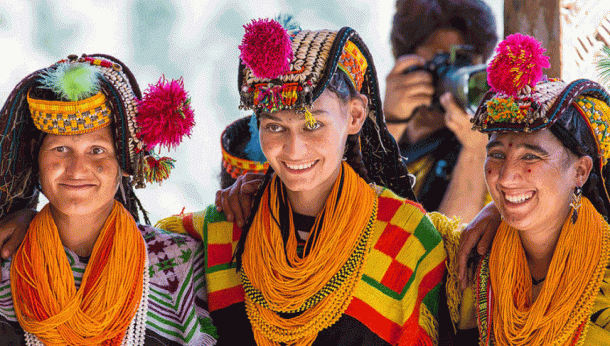
Pakistani hospitality catches most Western visitors off guard in the best way. Chai appears before you have settled into your chair. Questions about your family, your journey, and your impressions of Pakistan are asked with genuine curiosity. The desire to feed you well — and generously — is sincere and persistent. Lean into it. The food alone, from Karimabad’s dry-fruit markets to a simple roadside meal of daal and fresh roti, is worth the effort of the journey.
If you are seriously considering Pakistan for your next trip, the Pakistan tourist visa 2026 process is manageable — a form, a fee, and a few weeks of patience. What you get in return is access to some of the most extraordinary mountain landscapes on earth, with far fewer crowds than comparable destinations across South and Central Asia.
At Passage to Pakistan, we help travellers from the UK, the US, and across Europe plan private and small-group tours through the northern areas and beyond. We handle permits, logistics, accommodation, and local guidance so you can focus on the experience itself. Browse our Pakistan tour packages to see what a well-planned trip looks like, or get in touch with us directly — we are happy to answer your questions before you commit to anything.