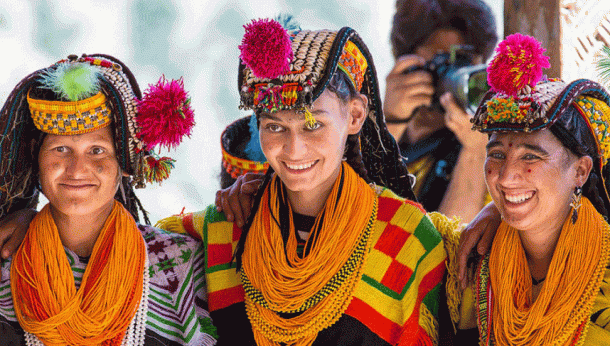
Picture this: you are standing at the edge of Attabad Lake in northern Pakistan. The water is that particular shade of turquoise that makes you wonder if someone has dyed it. A local family has waved you over from their boat and is pouring tea from a flask without asking whether you want any — because of course you do. Two travellers from Germany and Australia are taking photographs on the shore. Nobody is checking over their shoulder. Nobody looks tense.
That is the reality of the Hunza Valley in autumn, and it plays out this way every single day from spring through October. Yet before you booked your flight, you almost certainly typed “is Pakistan safe for tourists” into a search engine — so did tens of thousands of other curious travellers this year. This post is here to answer that question directly, with real numbers, honest caveats, and practical guidance from a team that has been organising trips for foreign visitors for years.
What the Numbers Say About Pakistan Safe for Tourists in 2026
The statistics tell a clear story. Over 1.3 million international tourists visited Pakistan in 2024 — a near 30 percent increase year-on-year — and that upward trend has continued through 2025 and into 2026. Visitors are arriving from the UK, Germany, Australia, the United States, Japan, and France. The vast majority return home with accounts of extraordinary hospitality, dramatic landscapes, and food they had not imagined possible. Very few have anything alarming to report.
Violent crime against foreign visitors is extremely rare. This is not marketing language designed to smooth over concerns — it is simply what the evidence shows. The more common complaint from foreign tourists in Pakistan is something far more benign: that too many people want a photograph with them, or that they cannot walk through a bazaar without being invited for tea. These are not hardships.
Several governments, including those of the United Kingdom, Germany, and Japan, have updated their travel advisories in recent years to reflect genuine improvements in major tourist areas and key cities. The Pakistani government has invested in safe tourism corridors, upgraded road infrastructure, and stationed dedicated Tourist Police in Lahore, Islamabad, Murree, and across Gilgit-Baltistan. There is also a 24/7 tourist helpline — dial 1422 through PTDC — that any foreign visitor can contact if they run into difficulty.
Which Parts of Pakistan Are Open to Foreign Tourists
Pakistan is a large country, and safety conditions are not uniform across it. Knowing where tourist-friendly infrastructure exists — and where it does not — is the most important research you can do before you travel.
The destinations that foreign tourists visit comfortably include Islamabad, Lahore, the Hunza Valley, Skardu, Fairy Meadows, the Swat Valley, Multan, Bahawalpur, Karachi's historic old city, and most of Interior Sindh. These are places with the roads, the accommodation, the local hospitality culture, and the governmental attention to support international visitors well.
There are areas that require much greater caution: Interior Balochistan, the former Federally Administered Tribal Areas (ex-FATA), and the border regions adjoining Afghanistan and Iran. These are not standard tourist destinations, and no reputable tour operator will include them on a typical itinerary. If you travel with a licensed Destination Management Company, your itinerary will be built entirely within the safe zones — which is one of the core reasons to use a professional partner when visiting Pakistan for the first time.
What Travelling in Pakistan Actually Feels Like
No statistic captures the texture of wandering through Lahore's Walled City at dusk, when the air carries the smell of hot oil from the karahi stalls and rose water from the shrine at Data Darbar, and every second shopkeeper is asking where you are from. Or the particular quiet of a mountain morning in Hunza — cold and clean, the kind of silence you can almost taste — before the valley wakes with goat bells and distant water.
Pakistan has one of the most genuine hospitality cultures in the world. Strangers will invite you for meals without any commercial motivation. Families stop their cars on mountain roads to check whether you need help. Children want to practise their English with you. This is not performance for tourists — it is simply how people here live.
First-time visitors are often surprised by how much works smoothly. Islamabad is a calm, green, well-organised capital. Lahore has a food scene of extraordinary range and some of the finest Mughal architecture on earth. The northern regions — Hunza, Skardu, Fairy Meadows — are among the most spectacular mountain landscapes on the planet. None of this requires compromising on comfort, particularly when travelling with a DMC that knows the country well.
Practical Steps to Travel Safely in Pakistan
Preparation separates a smooth first trip from a stressful one. Here is what actually matters before you go.
Register your travel with your government's official travel portal. British passport holders should use the FCDO Smart Traveller scheme; Americans can enrol in STEP (Smart Traveler Enrollment Program). This is not an admission that you are going somewhere dangerous — it means your embassy can reach you quickly if something unexpected happens anywhere in the world.
Get comprehensive travel insurance that specifically covers adventure activities and remote areas. Standard policies often exclude trekking above certain altitudes. Hunza sits at around 2,500 metres above sea level — make sure your policy covers it, and give yourself time to acclimatise properly on arrival. Do not rush the ascent.
Carry cash. ATMs exist in Hunza, Skardu, and other northern towns, but they can be unreliable. The further you travel into the mountains, the fewer electronic payment options exist. Stock up before you leave Islamabad or Gilgit.
Dress modestly, particularly outside major cities. Covering your shoulders and knees is a basic act of cultural respect, and people respond to the effort. Learn a handful of Urdu phrases too — “Shukriya” (thank you) alone will open more doors than you expect.
Planning Your First Trip to Pakistan
The travellers who come back raving about Pakistan — and many of them do come back, often within the same year to visit somewhere they missed the first time — are those who prepared properly and travelled with a reliable local partner. A good Destination Management Company knows which roads close in which months, which accommodation is genuinely comfortable, and how to build an itinerary that fits what you are actually looking for.
For a first visit, a structured Pakistan tour package removes the logistical uncertainty entirely and lets you focus on the experience rather than the planning. If Hunza is on your list — and it should be — dedicated Hunza Valley tours will take you from the Gilgit flight to the lake, the fort, the orchards, and the mountain views without a wasted day or a missed detail.
At Passage to Pakistan, we have been organising trips for foreign visitors since before the current tourism wave. We know this country deeply, we work with guides and accommodation partners we trust completely, and we will answer every question you have — about safety, the visa process, what to pack, what to expect — honestly and without spin. Reach out to us and let us help you plan the trip you have been thinking about.